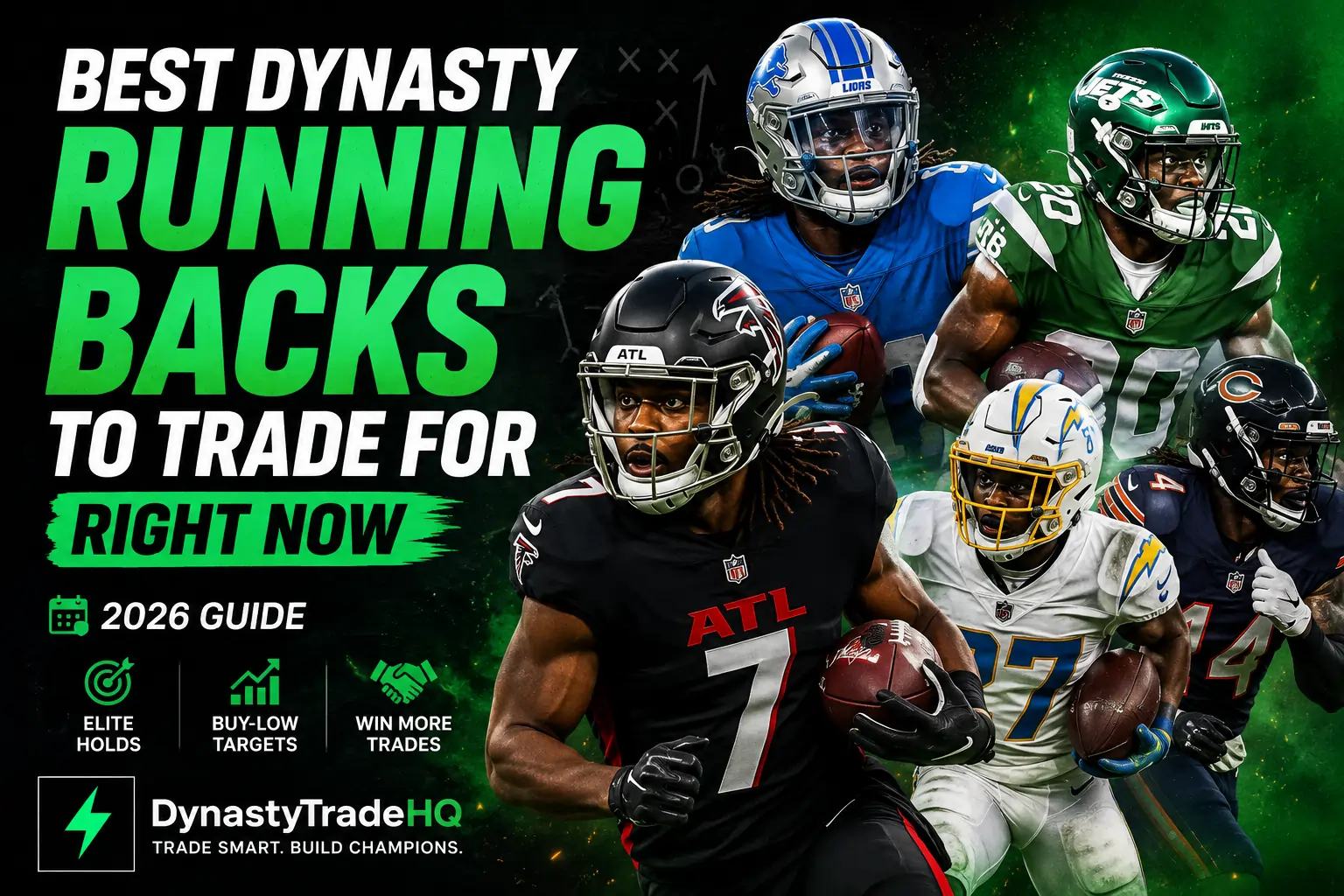
The running back position in dynasty is brutal. Values spike after breakout seasons, crash after injuries, and ownership rates rarely reflect actual long-term worth. If you want to win trades at the position, you need to know which RBs are still worth paying full price for, which ones are priced below their ceiling, and which ones to move right now before the market catches up. Here are the five running backs worth targeting in 2026, from elite holds to underpriced buy-lows. Before you move on to any of them, run the numbers on this trade through our calculator to see what you are actually giving up.
Table of Contents
Bijan Robinson: The Closest Thing to a Safe RB1 in Dynasty
Bijan Robinson is 24 years old, entering the 2026 season, and is widely ranked as the overall RB1 in dynasty formats. That price is steep, but it is justified. Robinson posted 2,298 yards from scrimmage in 2025 with 11 touchdowns across 17 games, averaging a career-high 5.1 yards per carry. His 30% tackle avoidance rate led the entire NFL. He also caught 79 balls on 103 targets, making him a reliable asset in PPR formats regardless of game script.
The situation around him is genuinely getting better, not worse. Former Falcons back Tyler Allgeier, who collected eight rushing touchdowns in a goal-line role in 2025, is gone. Brian Robinson Jr. has replaced him, but Robinson Jr. averaged only 92 carries in 2025 as a clear second option behind Christian McCaffrey. The goal-line volume that Allgeier was eating is now available to Bijan. Under new head coach Kevin Stefanski, a coach who built his reputation on running back-heavy offenses in Cleveland, Robinson could be in line for the best touchdown season of his career.
The knock on Robinson is the quarterback situation. Neither Michael Penix Jr. nor Tua Tagovailoa projects as a difference-maker, which likely suppresses Atlanta’s overall offensive ceiling. But Robinson has already shown across three NFL seasons that weak quarterback play does not stop him from producing at an elite level. His floor is consistently RB1-range production.
What to pay: Robinson is nearly impossible to acquire without surrendering a premium asset. You are looking at an early first-round pick in a startup draft, or a proven WR1 in a dynasty league. The player values page gives you a live sense of what he is trading for right now. Holding him is a free action. If you can get him for two early seconds and a young wide receiver, you win the trade.
Jahmyr Gibbs: The Case for the RB1 Conversation
Jahmyr Gibbs is 24 years old and making an argument that he, not Robinson, deserves the top spot in dynasty RB rankings. Over his first three NFL seasons, he has rushed for 3,580 yards and 49 total touchdowns in 49 games, averaging 5.3 yards per carry. He has also caught 181 passes for 1,449 receiving yards. For context: that is essentially one touchdown per game, sustained across three full seasons.
The Detroit Lions have already exercised Gibbs’s fifth-year option, locking him through 2027 at minimum. A contract extension is coming, and projections from multiple analysts suggest it could land between 3 years and $69 million and 4 years and $85 million, which would make him the highest-paid running back in NFL history. From a dynasty perspective, that level of investment from the front office signals long-term commitment. The Lions are not building a committee around Gibbs. He is the offense.
His dynasty ranking on KeepTradeCut sits at RB2, directly behind Robinson. Some analysts actually prefer Gibbs at this stage because his efficiency metrics slightly edge out Robinson’s over the same three-year period. He checks every box a dynasty manager should want: elite age curve, dual-threat skill set, a commitment to PPR volume, and an organization that actively prioritizes its own players.
What to pay: Gibbs commands the same range as Robinson. You need to give up an early first-round startup pick, or a starter-level player at another position. Check his profile at Jahmyr Gibbs for current trade comps. If you are choosing between Gibbs and Robinson, the edge goes to team context. The Lions’ offense is projected to be considerably stronger than Atlanta’s in 2026.
Breece Hall: A High-Floor Hold With One Legitimate Concern
Breece Hall just signed a three-year, $43.5 million contract extension with the New York Jets, worth up to $45.75 million with incentives, including $29 million in guaranteed money. That deal places him third among running backs by average annual value, behind only Saquon Barkley and Christian McCaffrey. He does not turn 25 until later this year. He is locked in, valued by the organization, and the clear workhorse back for at least the next three seasons.
The 2025 numbers back up the investment. Hall carried the ball 243 times for 1,605 yards on a Jets offense that finished 3-14. That is elite production on a terrible team. Under new offensive coordinator Frank Reich, with a healthy Garrett Wilson back and Geno Smith running the offense, the Jets have more weapons around Hall than they have had at any point in his career.
The one real concern is the Jets themselves. Their track record with Hall is 22-46. The 2026 draft class should bring quality quarterback options to New York in 2027, giving dynasty managers a clear path to a better situation. But if the Jets are bad again in 2026, Hall’s touchdown numbers may underwhelm relative to his workload. He is a strong hold and a reasonable buy if his current manager is selling out of frustration.
What to pay: Hall trades at a slight discount to Robinson and Gibbs because of the team situation. A first-round pick in the late range, or a solid young WR2, gets a deal done in most leagues. His profile at Breece Hall has recent trade comps to calibrate your offer. If you can buy him for a mid-first and a throw-in, that is a good trade.
Omarion Hampton: The Buy-Low With Real RB1 Upside
Omarion Hampton is 23 years old, was a first-round pick in 2026, and is already being called the most likely RB to move from Tier 2 to Tier 1 within the next 12 months by multiple analysts. The Los Angeles Chargers hired Mike McDaniel as offensive coordinator this offseason, which is exactly the kind of scheme upgrade that turns running backs into fantasy gold. McDaniel’s systems have historically featured the back as a receiving threat, which directly benefits Hampton’s development arc.
The buy-low window exists because his 2025 rookie season created genuine confusion in the market. Hampton dealt with a backfield split with Najee Harris, dealt with an injury that cost him games, and returned to find Kimani Vidal performing well in his absence. None of that changes his long-term ceiling. Hampton was a 1,500-plus-yard rusher in two consecutive college seasons at North Carolina. He is a big, physical runner who has the profile to handle a true workhorse role if given the chance.
The situation is not perfect right now, but it is trending in the right direction. Vidal is a practice-squad-caliber depth piece, and a McDaniel offense should lean on an athlete like Hampton. Dynasty managers should be targeting Hampton in the 30-to-40 percent cost range relative to what he was trading at during rookie drafts.
What to pay: A single mid-round pick, or a low-cost swap from a position of depth, gets you into Hampton negotiations. His value may never be lower than it is right now. Check the full dynasty RB rankings to see where he sits against his peer group. The reward-to-cost ratio here is among the best for the position.
Jeremiyah Love: Buy the Talent, Sell the Situation Concerns
Jeremiyah Love is 20 years old. He was selected third overall in the 2026 NFL Draft by the Arizona Cardinals, which gives him the draft capital that dynasty managers typically require at the top of startup drafts. The talent itself is not in question. He is explosive, versatile, and projects as a long-term fantasy RB1 based on everything he showed at Notre Dame.
The complication is the Arizona Cardinals. The run-blocking unit is not strong, and the offense under Kyler Murray has historically struggled to sustain rushing volume in positive game scripts. Love is likely to face negative game scripts regularly as a rookie. That means early-season production may be underwhelming even if his skill level is obvious to anyone watching film.
A buy-low target is a player whose value has dropped due to circumstance, not a decline in skill. Love fits that definition exactly. His dynasty ranking on KeepTradeCut has him as RB3 overall, but the practical reality of playing in Arizona in 2026 is keeping his market cost suppressed relative to that ranking. If you can acquire Love as the secondary piece in a package, you are getting a top-five dynasty back at a top-ten to top-fifteen price.
What to Watch Before Making the Move
The Murray situation is the variable to track. If Arizona demonstrates any ability to run the football in the first few weeks of the 2026 season, Love’s dynasty value will jump quickly. Patience is the asset here. Buy him now, before the situation sorts itself out, and let the market catch up over the next six to twelve months.
Should I Trade For Breece Hall or a Rookie?
The right answer depends on your roster timeline. Hall is a proven workhorse who just signed a three-year extension and has consistently produced at a high level. A highly drafted rookie like Love or Hampton offers a higher ceiling but real situation risk. If you are contending in 2026, Hall is the move. If you are two years away from a title run, Love or Hampton is the smarter buy.
Who Are the Best Dynasty Running Backs to Trade For Right Now?
The best dynasty running backs to trade for right now are Bijan Robinson and Jahmyr Gibbs at full price, Breece Hall at a slight discount, and Omarion Hampton or Jeremiyah Love if your league’s market has not caught up to their ceilings. Every trade is different, and price matters as much as the player. If you are on the fence about pulling the trigger on any of these names, put the trade through the calculator first.
Run Your Trade Through the Calculator
FAQs
Who are the best RBs to trade for in dynasty right now?
The best dynasty running backs to trade for right now are Bijan Robinson, Jahmyr Gibbs, and Breece Hall, among proven options. Robinson and Gibbs are RB1-tier at full price. Hall is a buy at a slight discount given the Jets’ situation. Omarion Hampton and Jeremiyah Love offer the best buy-low upside in the 2026 class.
Should I trade for Bijan Robinson in dynasty?
Yes, if you can afford the price. Robinson is the consensus dynasty RB1 entering 2026, coming off 2,298 scrimmage yards and a career-high 5.1 yards per carry. With Tyler Allgeier gone and new head coach Kevin Stefanski running a run-heavy system, Robinson’s goal-line and overall workload could increase. Expect to pay an early first-round pick or a proven WR1 in return.
Is Breece Hall worth trading for in dynasty?
Breece Hall is a strong dynasty hold and a reasonable buy at the right price. His three-year, $43.5 million contract extension with the Jets secures him as the team’s lead back through 2028. His 1,605-yard season in 2025 on a 3-14 team demonstrated elite efficiency on a heavy workload. The concern is that the Jets’ offense improves enough to unlock touchdown production.
Who is the best dynasty RB buy-low target in 2026?
Omarion Hampton and Jeremiyah Love are the top buy-low targets at running back in 2026. Hampton profiles as a scheme fit under Mike McDaniel in Los Angeles, but saw his value suppressed by a rookie backfield split. Love was the third overall pick with elite college production, but an unforgiving situation in Arizona is keeping his cost below his talent level.
