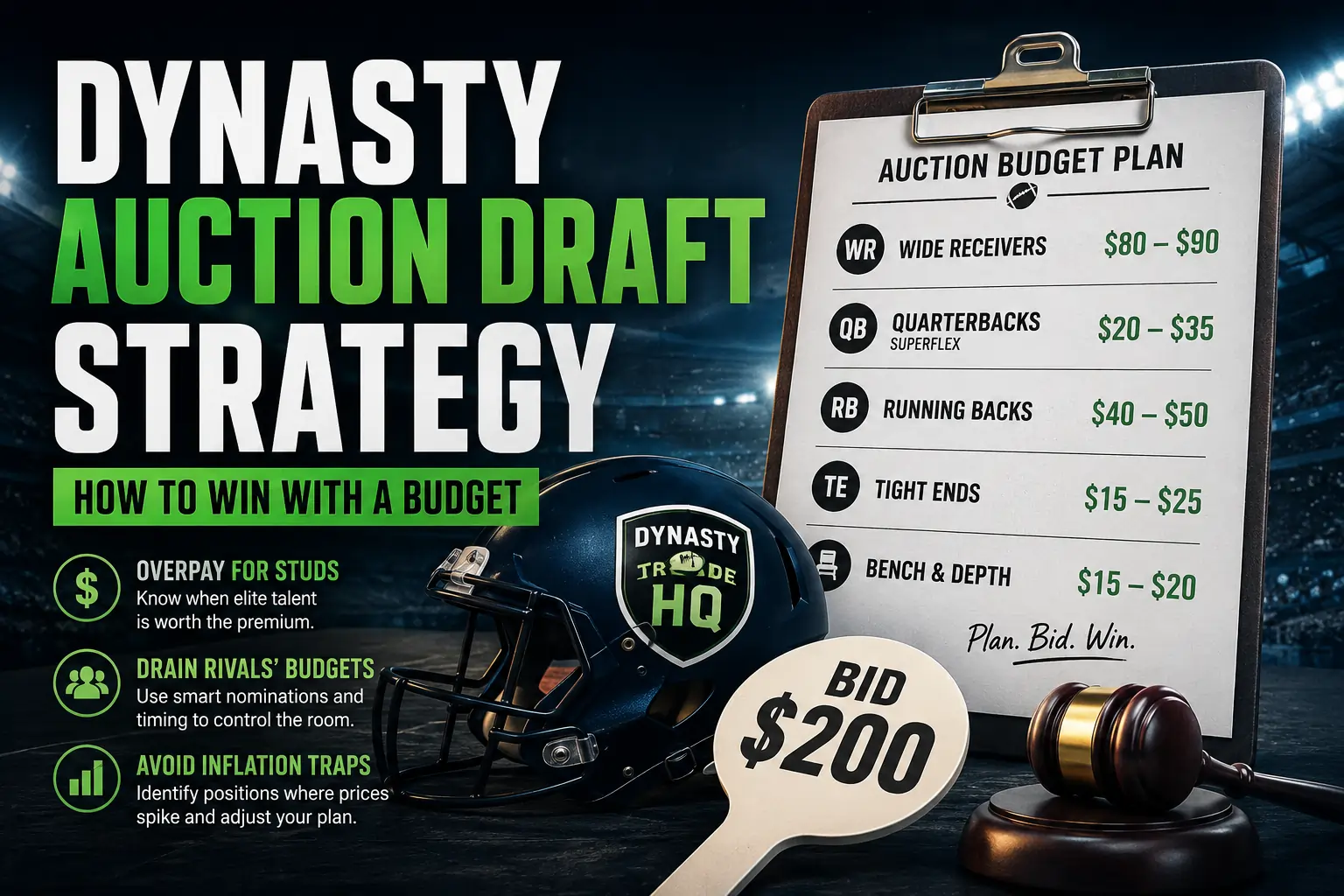
Most dynasty managers walk into an auction startup with a rough number in their head and no actual plan. That is how you end up with $3 left and four roster spots to fill. A smart dynasty auction draft strategy means knowing exactly how you will allocate your budget before the first nomination, which positions will inflate in your room, and when to let someone else overpay. Run this approach in your next startup, and you will build a deeper, more balanced roster than anyone who just “winged it.” Before the nominations even start, check your current dynasty values at dynasty player values so you walk in knowing what fair market looks like for every player you are targeting.
Table of Contents
How Auction Drafts Differ From Snake Drafts in Dynasty
A snake draft gives every manager one pick per round in a fixed order. An auction draft gives every manager a budget, usually $200, and lets them bid on any player nominated. The entire draft room is involved in every single nomination, which means there is no downtime and no safe slot to coast through.
The key structural difference in dynasty is that the stakes are compounded. In a redraft auction, you overpay for a receiver, and you eat it for one season. In a dynasty, that same overpay locks you into a bloated asset for years. A $60 bid on a receiver who returns $30 in dynasty value does not just hurt your team this year; it also limits your trade flexibility and cap-equivalent roster-building for the next two or three seasons.
The other major difference is competition parity. In a snake format, the manager at 1.01 has a structural advantage. In an auction, every manager has equal access to every player. The only variable is preparation and real-time decision-making. That means a well-prepared manager in an auction startup has a larger edge over the field than they would in any snake format. The room makes mistakes in real time: emotional bids, budget miscalculations, and FOMO spending. Your job is to avoid those mistakes while benefiting from everyone else’s.
One more distinction worth understanding: nomination order is a strategic lever in auction drafts that simply does not exist in snake formats. Who you nominate and when can shape the entire flow of the room’s spending, which is covered in detail later in this post.
Setting Your Budget Before the Draft Starts
A dynasty auction draft budget plan is not something you build on draft day. It is something you build the week before, and then adjust in real time as the draft unfolds.
The standard starting framework for a $200 budget in a 12-team startup looks like this:
- Wide receivers: $80 to $90 (the position that holds dynasty value longest)
- Quarterbacks: $20 to $35 in Superflex, $10 to $15 in 1QB
- Running backs: $40 to $50
- Tight ends: $15 to $25
- Bench and depth: $15 to $20 in reserve
These are soft targets, not hard rules. The point of pre-draft budgeting is to walk in with a clear mental ceiling on each position so you do not accidentally spend $70 on two running backs and leave yourself with nothing for receivers.
The most common budget mistake in dynasty auction drafts is spending too fast in the first third of the draft. The opening 20 to 30 nominations usually feature the most expensive names, and the room tends to bid emotionally at that stage. If you are chasing every stud, you will run dry before the mid-tier players come up.
A practical approach: enter the draft willing to miss any single player. Your plan should never depend on winning one specific bid. If you have a hard ceiling of $55 for a particular wide receiver and the room pushes him to $58, let him go. The manager who paid $58 just compromised three other roster spots to do it.
Before your draft, cross-reference your budget allocations against the latest dynasty rankings to make sure your positional spend lines up with where actual value sits this cycle.
When to Overpay for Studs vs. Spread the Budget
There is a genuine tension in auction strategy between concentrating spend on elite players and distributing it for roster depth. Both approaches can win. The question is which one fits the room you are sitting in.
Overpaying for a stud in dynasty makes sense under one condition: the player’s dynasty value justifies a premium above their auction price because the room is undervaluing them. Paying $65 for a 24-year-old wide receiver with three years of elite production ahead is not overpaying; it is accurate pricing. Paying $65 for the same receiver because you panicked and got into a bidding war is overpaying.
The tent-pole approach, where you anchor your roster around two or three elite players at premium prices, works well in dynasty when those players are young. A 23-year-old receiver at $60 ties up budget in year one but gives you an appreciating asset for years two through five. The math works in dynasty in a way it does not in redraft.
The spread approach makes more sense when the top tier is inflating above the dynasty market price. If every top receiver in your room is going $10 to $15 above realistic dynasty value, buying three solid second-tier receivers at fair prices is a better long-term position than winning one inflated bid.
The honest answer for most rooms: spend big on one or two genuinely elite young players you’re convinced of, then be disciplined and patient everywhere else. Do not chase a third stud just because you have budget left. Mid-range value across the rest of your roster compounds in dynasty the same way it does in any long-term asset portfolio.
Use the DynastyTradeHQ trade calculator to model what those players are worth in a trade context before you decide your ceiling on draft day.
Nomination Strategy: Drain Budgets Before You Build Your Roster
Nomination strategy is the part of dynasty auction drafts that most managers ignore entirely, and it is where the real edge lives.
The core principle is simple: nominate players you do not want, specifically players you know other managers in the room want. Your goal in the first third of the draft is to get other people to spend money before you spend yours.
If you know the manager to your left runs a receiver-heavy strategy, nominate the receiver they have been talking about all offseason. Force them to pay early, when emotions are high, and budgets are untouched. Every dollar they spend on that nomination is a dollar they cannot spend later when you are targeting your own players.
Nominating high-profile running backs early is particularly effective in dynasty auction drafts. Running backs tend to trigger emotional bids because managers know they are scarce and short-lived as assets. A 26-year-old feature back who puts up early numbers will often draw bids above his dynasty value because managers are afraid to miss him.
A second nomination tactic: put up players in positions where you are already well-stocked. If you have your quarterback situation locked in, nominate other quarterbacks early to drain budgets from Superflex managers. This feature only works if you have done your homework on where the other managers in your room are trying to build.
The one exception is the very first nomination of the draft. First nominations often go below market because the room has not warmed up, and no one wants to overpay with a full budget sitting unused. If there is a mid-tier player you genuinely want, nominating them first can get you a deal the room would not have let slide 20 nominations later.
Positional Inflation Patterns in Dynasty Auction Drafts
Positional inflation occurs when a position group costs more in aggregate at auction than the dynasty’s actual value would justify. Every auction room develops its own inflation patterns, but there are consistent tendencies across dynasty formats.
Wide receivers inflate almost universally. Dynasty managers know that the receiver position is the most durable for long-term value, so the room collectively bids up the top of the position. The top eight to ten receivers in any startup auction will routinely exceed fair dynasty market price by 10 to 20 percent. This feature does not mean you avoid the position; it means you set a hard ceiling and do not chase past it.
Quarterbacks in Superflex inflate dramatically and in a specific pattern. The top two or three quarterbacks go at predictable prices. Then there is a cliff where prices drop sharply before inflating again as managers realize they still need a starter. If you are in Superflex and you miss the top tier, wait through the panic zone and buy your second quarterback at a genuine discount. Check the QB dynasty rankings before your draft so you know exactly where that cliff sits.
Running backs inflate based on perceived scarcity rather than dynasty value. The top two or three backs in a startup tend to go close to fair value or slightly above. The problem is the fourth through eighth ranked backs, where managers start bidding on role and volume projection rather than confirmed dynasty track record. That is where the room overpays most consistently.
Tight ends are the quietest inflation zone in most rooms. Unless a truly elite option is available, the position tends to settle at or slightly below fair dynasty value because managers deprioritize it relative to the skill positions. That can be an opportunity to lock in a solid tight end at a genuine discount if you are patient.
Is a Dynasty Auction Draft Strategy Worth Learning?
Yes, and the gap between a prepared auction manager and an unprepared one is wider than in any other draft format. Knowing your budget splits, nomination targets, and positional inflation tendencies before the first bid goes in is the single biggest structural edge available in a dynasty startup.
The floor on a smart auction is a deep, balanced roster. The floor on a poor one is a star or two surrounded by roster filler you bought at panic prices. The difference is almost entirely preparation.
Before your next startup auction, know exactly what each player on your target list is worth in trade. Run Your Trade Through the Calculator
FAQs
How much should I spend in a dynasty auction draft?
In a standard $200 budget, allocate $80 to $90 to wide receivers, $40 to $50 to running backs, $20 to $35 to quarterbacks in Superflex, and $15 to $25 to tight ends. Reserve $15 to $20 for bench depth.
What is the best auction draft strategy for dynasty?
Combine a pre-set positional budget, disciplined nomination tactics to drain rivals’ money early, and hard ceilings on every player. Spend big only on young elite players whose dynasty value justifies the price, then allocate the rest to roster depth.
Should I overpay for elite players in a dynasty auction?
Overpaying for a young elite player can be correct if his long-term dynasty value exceeds the auction premium. A 23-year-old receiver slightly above fair value may still be cheap relative to his ceiling two or three seasons from now.
How does nomination order work in a fantasy football auction draft?
Managers take turns nominating players for the room to bid on. Nominate players you do not want to force rivals to spend on early, then hold off on your own nominations until budgets are partially drained. It is one of the clearest edges in auction drafts.
