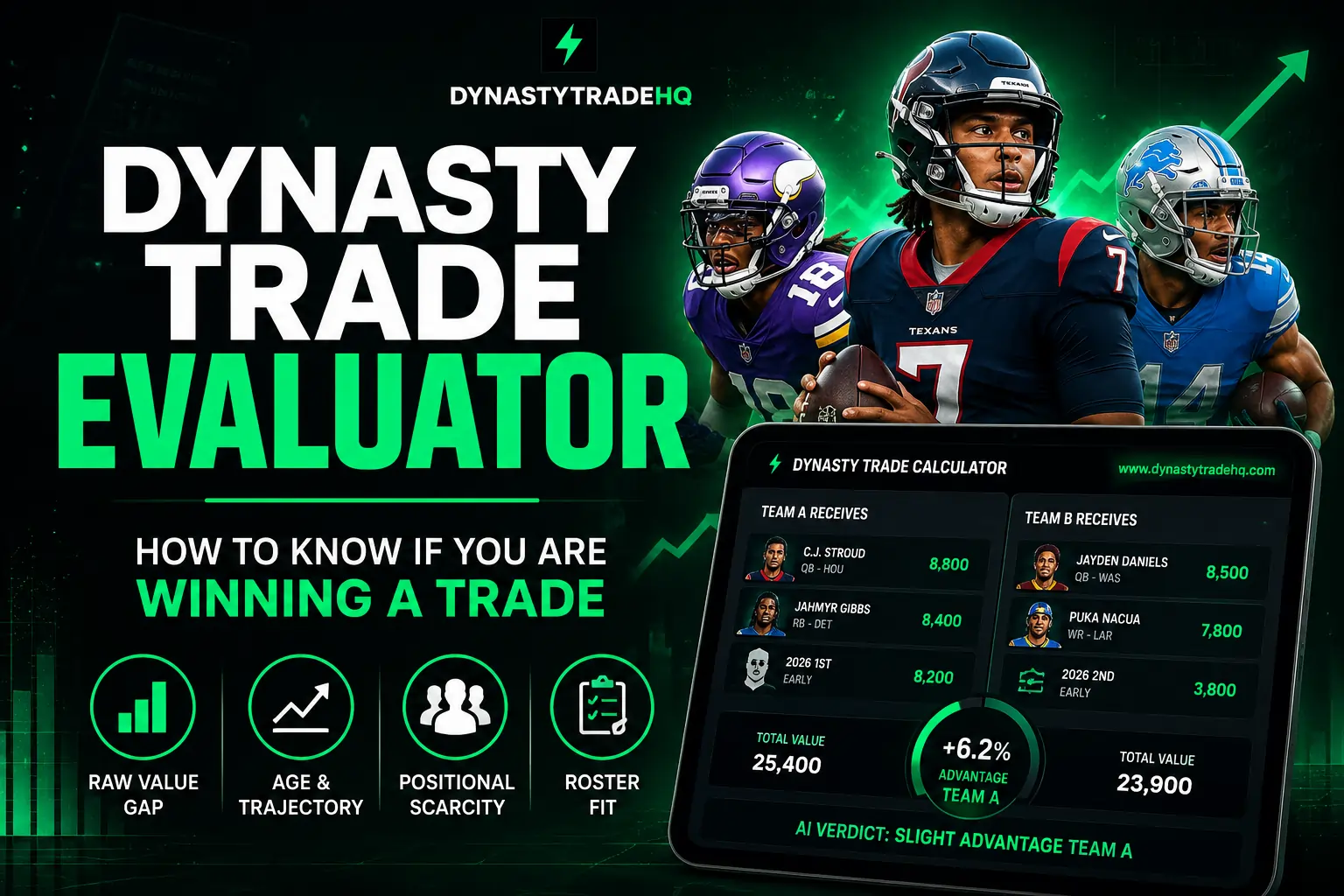
Most dynasty managers know when a trade feels wrong. The harder problem is knowing when a trade is actually wrong. This guide gives you an objective evaluation framework you can run on any deal before you respond, so you stop relying on gut feel and start making decisions backed by a repeatable scoring system. Before applying the steps below, plug the deal into the trade calculator at www.dynastytradehq.com to lock in your baseline numbers first.
Table of Contents
What a Dynasty Trade Evaluator Actually Measures
A dynasty trade evaluator is a structured scoring system that compares assets on both sides of a deal across multiple dimensions, not just raw trade value. Raw value tells you whether the numbers are even. A proper evaluation framework tells you whether the trade moves your roster in the right direction given your current situation. The distinction matters because two managers in the same league can make the exact same trade and one can win it while the other loses. A contender trading a 2027 first for a proven starter is a sensible decision. A rebuilder making that same move is burning future capital to tread water.
The four dimensions a complete dynasty trade evaluator measures are: current production value, age and trajectory, positional scarcity, and roster context fit. Most managers only check the first one. They pull up a trade value chart, see that the numbers are close, and accept. That is how you end up with a technically fair trade that sets your team back two years. Current production value is your baseline. It anchors the negotiation and tells you neither side is being robbed outright. But it is a starting point, not a verdict. A player can be fairly valued today and still be the wrong asset for your specific team.
The evaluation framework does not replace the calculator. It runs on top of it. Start with the numbers, then layer in the qualitative scoring. Any trade that clears the calculator but fails two or more of the other three dimensions deserves a second look before you click accept. Before moving forward on any deal, check where every player involved sits on the dynasty rankings board so you have positional context; the raw value numbers do not always surface on their own.
Step One: Score the Raw Value Gap
The first step in any objective evaluation is identifying the raw value gap between the two sides of a deal. If the gap is greater than ten percent in either direction, you are either overpaying or underselling, and you need a clear reason to accept that imbalance before moving forward. A raw value gap under five percent is effectively a fair trade. Gaps between five and ten percent are negotiating room, which means you should be pushing for a small sweetener rather than walking away.
Gaps above ten percent require a strong contextual reason to close. That reason could be roster need, positional scarcity, or a buy-low opportunity where you believe the calculator is undervaluing a player due to a temporary slump. How to score this step: plug the trade into www.dynastytradehq.com and note the percentage gap. Assign a green light if the gap favors you or is under five percent, a yellow light if the gap is between five and ten percent against you, and a red light if the gap exceeds ten percent against you. One yellow light in a five-step evaluation does not kill a trade. Red lights are what you track.
Two red lights across the full framework mean you renegotiate or walk. Three red lights mean the trade is not happening unless the other manager makes significant adjustments. Knowing the raw value gap is foundational because it also tells you where you have leverage in a counter. If the gap is eight percent against you, you know exactly what size sweetener to request to bring the deal into range. That is a much stronger negotiating position than telling yourself something does not feel right.
Step Two: Evaluate Age and Trajectory Independently
Age and trajectory are two separate inputs, and they should be scored separately. Age alone does not tell you enough. A 28-year-old wide receiver on a productive offense with a history of durability is a very different asset from a 28-year-old running back coming off a soft 2025 season. Trajectory is the direction the player is heading right now. A player on an upward trajectory is producing above his age expectation. A player on a flat trajectory is performing exactly as his age and situation predict.
A player on a downward trajectory is underperforming his age expectations, which can mean skill decline, opportunity loss, or injury risk compounding. Score age by position. Running backs age out of dynasty relevance earlier than wide receivers and quarterbacks. A running back over 26 carries a meaningful age penalty even if his current value is strong. A wide receiver at 27 with a clean injury history is still in a productive window. A quarterback at 30 in a functional offense retains significant trade value. The positional age curves are reflected in the consensus data at quarterback dynasty rankings, which shows how the market prices quarterbacks across age tiers in both 1QB and superflex formats.
Score trajectory by asking a direct question: is this player’s situation more stable or less stable than it was six months ago? A new offensive coordinator, a change in target share, or a backfield committee emerging behind a running back are all trajectory signals. They do not always move a player’s raw value immediately, but they move his actual dynasty outlook. Assign a green light if both age and trajectory favor the player you are receiving. Yellow if one is neutral. Red if the player you are receiving is on the wrong side of either his positional age curve or his situational trajectory.
Step Three: Price Positional Scarcity Into the Deal
Positional scarcity is one of the most underpriced variables in dynasty trades. Trade value charts assign a number to a player. They do not tell you how difficult it would be to replace that player’s contribution at his position through the waiver wire, a future draft, or another trade. A scarcity premium exists when a player occupies a position where elite production is rare and concentrated at the top. Tight end is the clearest example. The gap between a top-three tight end and the rest of the position in dynasty is wider than at any other spot on the roster.
Trading away a locked-in top-three tight end for fair value in raw numbers is often still a bad trade because you cannot replace what you gave up without paying a premium somewhere else later. Wide receiver is the deepest position in dynasty. The gap between receiver 12 and receiver 20 is much smaller than the equivalent gap at tight end or quarterback in superflex formats. This means you can absorb a slight raw value loss trading a wide receiver if it lets you acquire a scarce positional asset.
Score this step by asking: is the player I am receiving easier or harder to replace than the player I am giving up? Easier to replace gets a yellow or red light. Harder to replace gets a green light. This is also where roster holes matter. If you have no viable tight end on your roster, the scarcity premium for a reliable one is even higher.
Step Four: Align the Trade With Your Roster Window
Every dynasty team exists in one of three states: contending, rebuilding, or retooling. The correct trade for each state is different, and a deal that makes perfect sense for a contender can be actively damaging for a rebuilder making the same move. A contending team should weigh current production above future upside. Accepting a slight age penalty or giving up a future pick to acquire a proven starter in a championship window is a reasonable trade-off. The goal is to maximize the window you already have open.
A rebuilding team should weigh age and picks above current production. Trading veterans for draft capital is the mechanism of a rebuild. Accepting players on the back half of their careers, even at fair value, slows the rebuild down because you are adding assets with declining trajectories instead of rising ones. A retooling team sits between the two. The retooling manager is trying to stay competitive in the short term while improving long-term upside. For this roster state, the most important evaluation question is whether the trade improves both the current window and the future state simultaneously. Trades that do only one are acceptable. Trades that hurt both are the ones to walk away from.
Score this step by listing your team state honestly, then asking whether the trade moves you further into that state or away from it. A trade that moves you away from your stated roster direction is a red light regardless of what the raw value numbers say. If you want a deeper breakdown of how to put a specific number on what individual players are worth to your roster construction, the valuation methodology is covered in detail at player worth dynasty trade value guide, which walks through how context shifts what a player is actually worth to your specific team versus the market average.
Step Five: Run the Final Tally and Negotiate From It
The final step of the dynasty trade evaluator framework is totaling your lights across all four dimensions and using the result as a negotiating position, not just a yes-or-no answer. Here is the scoring key. Four green lights and one yellow: accept the trade. Three green lights and two yellows: accept or ask for a minor sweetener. Two green lights and any red light: counter with a specific ask. One green light or more than one red light: decline or restructure the deal significantly.
The value of this framework is that it converts a subjective feeling into a specific number. When you counter a trade, you are no longer saying something does not feel right. You are saying the age trajectory on this running back is a concern at his price, so you need the 2027 second added to make this work. That is a negotiable position. Feelings are not.
Most managers who lose trades do not lose them on the value check. They lose them because they accepted a technically fair deal that pointed their roster in the wrong direction. The framework catches that before you click accept. Cross-reference where individual players sit before you finalize any counteroffer by checking the player values page. Knowing the exact value of what you are asking for puts you in a much stronger position than requesting something extra without a number attached.
One final note: this framework is a tool, not a veto. Trades are also negotiations between humans, and league relationships matter. A deal that scores two yellows but strengthens a rivalry or prevents a stronger manager from upgrading might still be worth accepting. The framework tells you the cost. How you weigh that cost is still your decision. For a broader breakdown of the tactics that separate winning dynasty traders from losing ones, the strategic layer that sits above evaluation is covered in full at how to win dynasty trade guide, which pairs well with this framework once you have your scoring system locked in.
Is This Trade Worth Accepting?
Run every deal through all five steps before you respond. One red light is a counter. Two red lights is a restructure. Three is a decline. The framework removes the guesswork and gives you a clear position every time. Stop trading on instinct when a five-step framework takes three minutes to run.
Run Your Trade Through the Calculator
FAQs
What is a dynasty trade evaluator?
A dynasty trade evaluator is a structured framework that scores a trade across multiple dimensions including raw value, age, trajectory, positional scarcity, and roster fit. It goes beyond a simple value chart comparison by measuring whether a trade moves your specific team in the right direction, not just whether the numbers are even on paper.
How do I know if I am winning a dynasty trade?
You are winning a dynasty trade when the assets you receive score higher across the five evaluation dimensions: the value gap favors you or is within five percent, the players coming in have favorable age and trajectory, they fill a scarce positional need, and the deal aligns with your current roster window. All five should be green or yellow before you accept.
Should I always use a trade calculator in dynasty fantasy football?
A trade calculator should be your first step on any dynasty trade, not your only step. The calculator tells you whether the raw value is fair. It does not account for your roster state, your positional needs, or whether a player’s trajectory is moving up or down. Use the calculator to set a baseline and layer your evaluation on top of it.
What is a fair trade value gap in dynasty?
A fair trade value gap in dynasty is generally under five percent in either direction. Gaps between five and ten percent are in the negotiating room where a small sweetener closes the deal. Any gap above ten percent requires a strong contextual reason to accept, such as buying low on a slumping player you believe is undervalued by the market at that moment.
