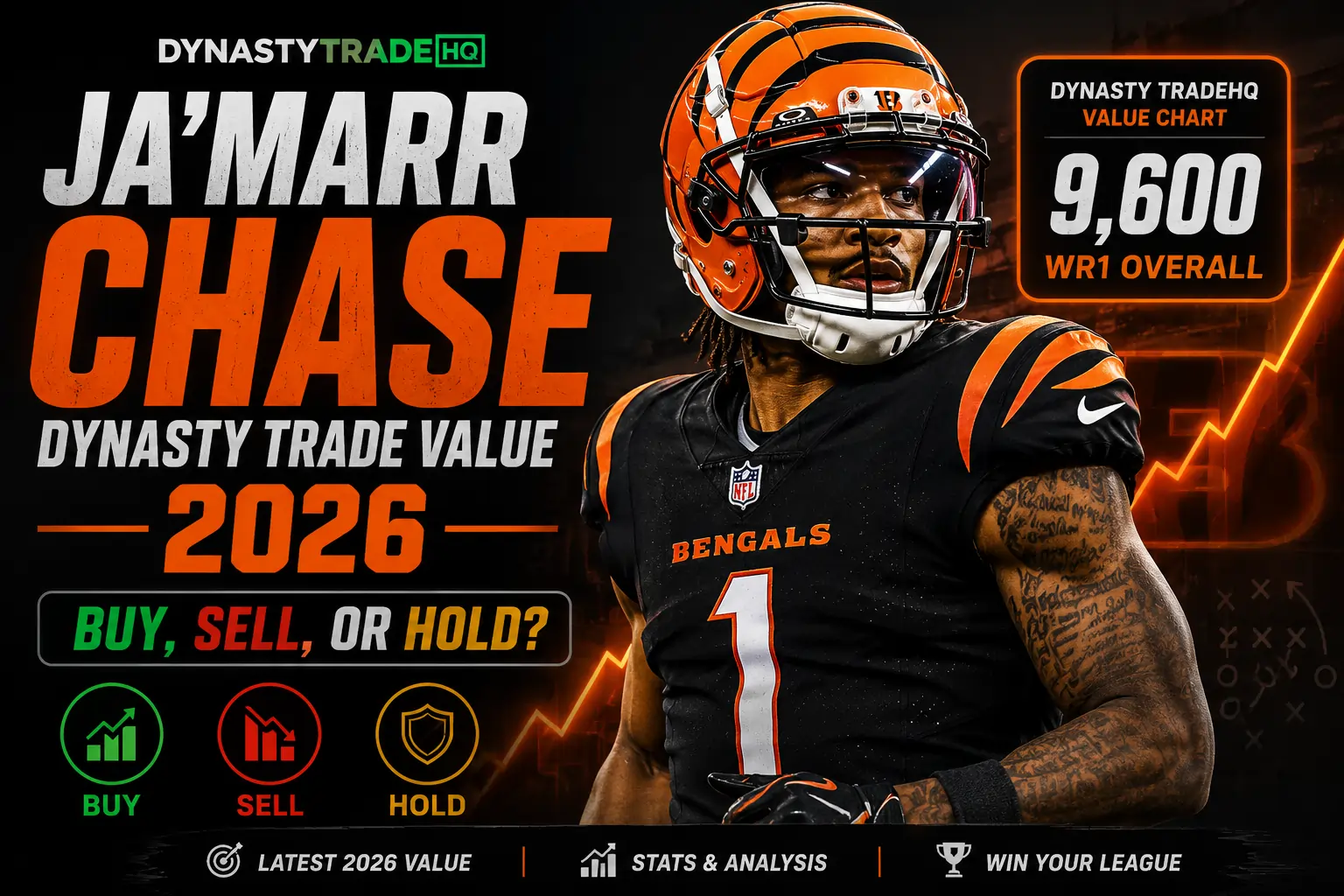
The decision you are staring at right now is whether the best wide receiver in dynasty football is worth moving. Ja’Marr Chase dynasty trade value sits at 9,600 on DynastyTradeHQ’s value chart, making him the WR1 on the site and one of the top three overall dynasty assets in the game. The verdict for most managers is hold, and this post will tell you exactly why, plus the one narrow case where selling makes sense and what a fair return looks like if you do.
Table of Contents
Where Ja’Marr Chase Stands Right Now
Ja’Marr Chase is the consensus WR1 in dynasty football entering 2026, and the numbers back that up completely. He closed out 2025 with 125 receptions, 1,412 yards, and 8 touchdowns on 185 targets across 16 games, leading the NFL in targets for the season. That happened in a year when Joe Burrow missed time with a toe injury. Chase produced at an elite level without a fully healthy quarterback, which tells you everything about his floor.
At 9,600 on the DynastyTradeHQ trade value chart, he sits at the top of the WR rankings. The closest competition at the position is a meaningful gap below him. On KeepTradeCut, he ranks third overall in Superflex leagues behind Josh Allen and Bijan Robinson. The positioning difference across sites is a format conversation, which is covered below. Across all major dynasty platforms, he is a top-five asset.
You can pull his full player profile, including value history and positional rank, at https://dynastytradehq.com/players/jamarr-chase. If you are in an active trade negotiation right now, run the numbers on this trade on the calculator before you respond to any offer. His value is not a mystery, and knowing exactly where he sits gives you leverage in any discussion.
The Case to Hold Ja’Marr Chase
Hold is the correct call for the vast majority of dynasty managers, and the age argument alone closes the debate. Chase turns 26 in March 2026. Wide receivers at that age are entering or approaching their absolute peak production windows. He is not in decline territory. He is not even close to declining territory. The players who get sold at this age are the ones whose value you are trying to capture before the drop, and there is no credible drop on the horizon here.
The contract structure reinforces this completely. Chase signed a four-year, $161 million extension with $112 million guaranteed, locking him into Cincinnati through the 2029 season. There is no contract uncertainty, no franchise tag drama, no pending free agency that could disrupt his situation. He will be a Bengal for the foreseeable future, catching passes from Joe Burrow, who is now fully healthy entering 2026.
That Burrow connection is the single most important contextual factor in Chase’s dynasty value. Burrow is one of the most accurate and volume-generating quarterbacks in the NFL when healthy. The Bengals’ offense runs through Chase at the route level, and that is unlikely to change. Chase has back-to-back first-team All-Pro seasons on his resume. The argument for selling has to overcome all of that, and for most roster compositions, it simply does not.
If you own Chase and your team is competing, he is the centerpiece of your window. If you are rebuilding, the question changes slightly, but even then, the return has to be overwhelming to justify moving him.
The Case to Sell Ja’Marr Chase
Selling Chase is defensible in exactly one scenario: you are in a full rebuild, your window is years away, and you can extract a haul that structurally sets your team up. Even then, it is debatable, and most managers who sell a 26-year-old WR1 at peak value end up regretting it within two seasons.
The case for selling rests on value maximization at the top of the market. Chase’s dynasty trade value is at its ceiling right now. He just posted another 1,400-yard season, he has a massive new contract, and the dynasty community has him rated as the WR1 across nearly every major platform. You will not get a higher return than you can get today, and that is the core selling argument.
The problem is what you are giving up. Chase is not just a high-value player in the abstract. He is the kind of asset that wins fantasy championships when your roster is constructed around him. Replacing that production from the trade return is genuinely difficult. The players who come back in a Chase trade are good, but they are not Chase.
Sell only if: your team is at least two to three years from contending, the offer includes two first-round picks plus a young WR2 or ascending RB with real upside, and you have a clear plan for what those assets do for your rebuild. If the offer does not meet that bar, the correct move is to ask for more or walk away from the table.
The Case to Buy Ja’Marr Chase
Buying Chase at a slight discount is the best trade you can make in dynasty football right now. The discount scenario happens in two situations: the other manager is spooked by a single down game or a short cold stretch, or they are chasing a quick rebuild and are willing to eat a value loss to move fast.
A buy-low target is a player whose value has dropped due to context, not a decline in ability. Chase’s 2025 production dipped from his 2024 campaign of 1,700 yards and 17 touchdowns, and that dip, combined with Burrow’s absence due to injury, has created just enough uncertainty in some managers’ minds to make them open to moving him at a discount. That uncertainty is not justified by the underlying talent or situation.
If someone is offering you Chase for one first-round pick and an established contributor, you take that deal without hesitation. If the ask is slightly above your comfort level, use the trade calculator to see exactly where the gap is and whether you can close it with a restructured offer.
The buy window on a 26-year-old WR1 locked into a record contract in a pass-heavy offense does not stay open for long. Managers who sell at a slight discount usually correct back to market rate within weeks once the next big production game drops.
Format Differences: 1QB vs. Superflex
Chase’s dynasty trade value varies by league format, and understanding this distinction affects how you negotiate any trade involving him.
In 1QB leagues, Chase is the undisputed WR1 asset in the entire format. Quarterback value is capped because you only start one, so skill position players like Chase command maximum value. His 9,600 score on the DynastyTradeHQ value chart reflects his 1QB standing as the top non-quarterback dynasty asset. You can check the full trade value chart to see how the gap between Chase and the next WR looks in that format.
In Superflex, the calculus compresses slightly. Starting a second quarterback means elite QB assets like Josh Allen carry enormous dynasty value, and those assets compete directly with Chase in any trade negotiation. This is why KeepTradeCut has Chase ranked third overall in Superflex behind Allen and Bijan Robinson. He is still a top-three dynasty asset, but his relative value against the top quarterbacks narrows in that format.
The practical implication is this: if you are in a Superflex league and someone is trying to trade you Chase as if his value equals an elite QB1, push back. He is a top-three asset, not a top-one. In 1QB, the conversation is different. He is the WR1 and should be traded as such.
What Is a Fair Trade Return for Ja’Marr Chase?
This is the section most readers actually need. If you are selling Chase, you need to know the minimum acceptable return before you open negotiations.
The floor for any Chase trade is one first-round pick plus an established WR2 or a young running back with proven upside. That is the starting point. Anything below that floor means you are selling the WR1 at a discount for no structural reason.
The realistic return in a competitive offer looks like this:
- Two first-round picks (at least one in a near-term class) plus a starting-caliber player at WR or RB
- One first-round pick plus two strong young players with clear starter trajectories
- A premium first-round pick (top-three protected) plus an established WR2 on a young contract
What you should not accept: a single mid-round pick and a filler player, a package built entirely around future picks with no proven NFL contributor included, or an offer where the total DynastyTradeHQ value of the return package is materially below 9,600 before you even factor in the depth loss.
If you want exact numbers for a specific offer, the dynasty trade calculator will tell you the value in seconds. Do not negotiate blindly when the data is available.
Should You Trade Ja’Marr Chase in 2026?
Hold Chase unless someone is willing to massively overpay. He is 26 years old, locked into Cincinnati through 2029 on a record contract, paired with a fully healthy Joe Burrow, and coming off back-to-back All-Pro seasons. The case for selling is narrow. The case for holding is overwhelming.
If you have an offer on the table for Chase right now, run both sides through our calculator before you respond.
FAQs
What is Ja’Marr Chase’s dynasty trade value right now?
Chase’s dynasty trade value sits at 9,600 on DynastyTradeHQ, making him the WR1 on the site. He ranks as a top-three overall dynasty asset, with his exact standing depending on league format.
Should I trade Ja’Marr Chase in my dynasty league?
Most managers should hold Chase rather than sell him. He is 26 years old, posted 1,412 receiving yards in 2025 despite not having a fully healthy Joe Burrow, and is under contract in Cincinnati through 2029. The only strong reason to sell is if you are rebuilding and can secure two first-round picks plus a young contributor in return.
Is Ja’Marr Chase worth trading for in dynasty?
Yes, Chase is worth acquiring if you can get him at or below his market value. He profiles as the highest-floor and highest-ceiling WR in the format at his age, making him a strong buy for any contending roster.
What is a fair trade for Ja’Marr Chase in dynasty?
A fair return for Chase, as the trade piece you are giving up is at least one first-round pick plus an established WR2 or ascending RB. A realistic competitive offer is two first-round picks plus a young starter. Use the DynastyTradeHQ trade calculator to check whether any specific offer meets that standard before you accept.
