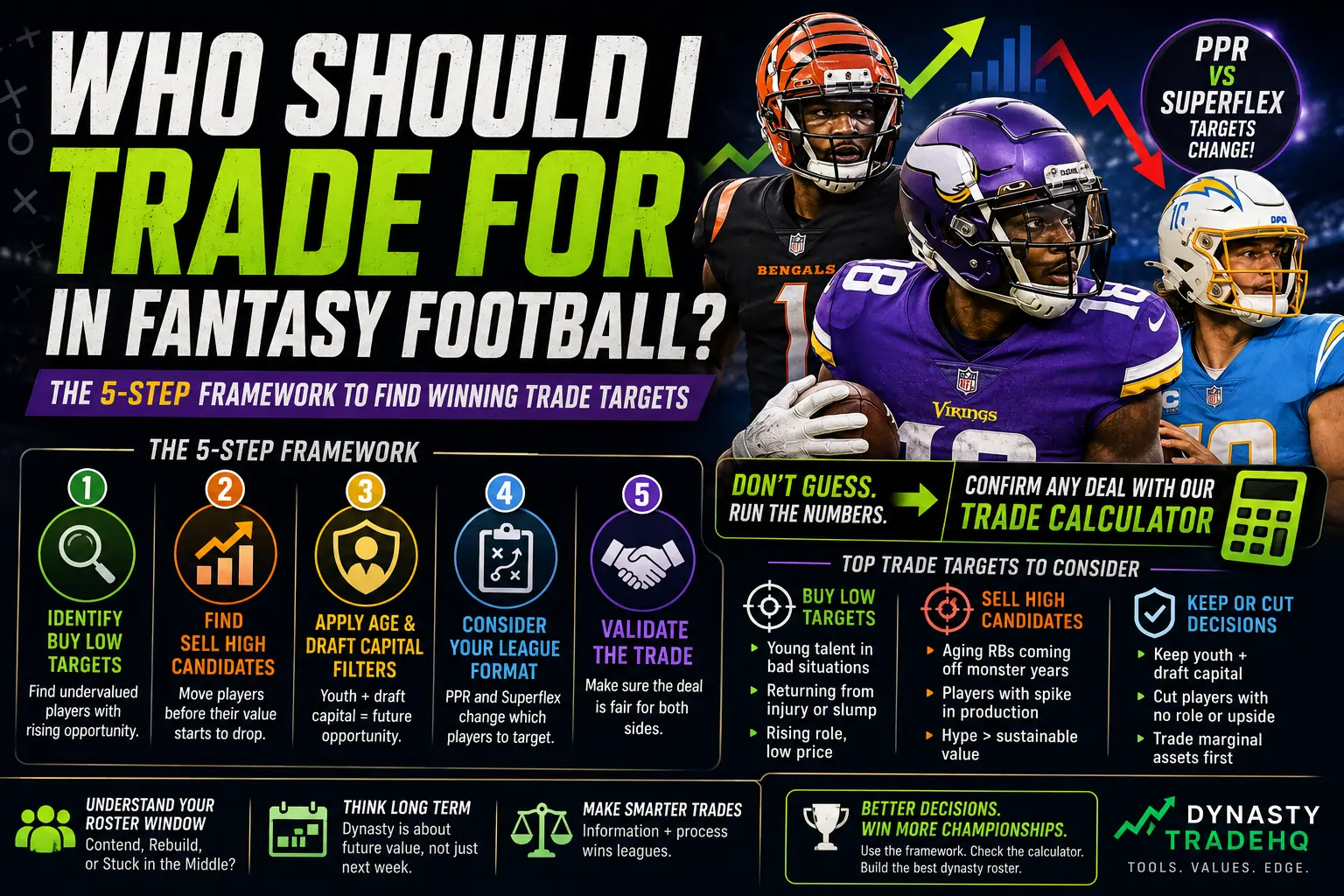
You do not need a gut feeling to answer who should I trade for in fantasy football. You need a repeatable process that filters players by age, opportunity, and format, then points you toward the calculator to confirm the numbers work. This guide breaks that process into five steps you can apply to any dynasty roster today. Before you finalize a deal, run the numbers on this trade through a calculator to confirm that both sides line up.
Table of Contents
What “Who Should I Trade For” Means in Dynasty
Asking who should I trade for in fantasy football is really two questions stacked together. First, which players have rising long term value that your league mates are not pricing correctly. Second, which of your own players have value today that will not hold twelve months from now?
A trade target is any player whose expected future production exceeds what the market currently charges for him. That gap can come from a role change, a crowded depth chart clearing out, or simple recency bias after a slow stretch. Dynasty managers who consistently win trades are the ones who separate a player’s box score from his actual opportunity.
This is different from redraft thinking, in which you care only about the next few weeks. In dynasty, a rookie on a bad offense with a real market share matters more than a veteran on a good offense with a shrinking role. Keep that distinction in mind every time you evaluate a target, because it changes who belongs on your trade list versus your watch list.
Buy Low: Who You Should Trade For Right Now
The clearest buy low target is a player whose value dropped because of a slump, not because of a decline in skill. Look for players who lost target share or touches to an injury ahead of them on the depth chart, not because a coaching staff lost confidence in their talent.
Three signals point to a real buy low candidate:
The player still has clear athletic traits that match his draft capital and college profile. The offense around him is stable or improving, not a unit in full rebuild mode. His current price reflects one bad stretch rather than a multi-season pattern.
A second category worth targeting is the ascending player stuck behind a veteran. If a young receiver or running back is clearly earning more snaps each month but the veteran ahead of him still holds the name value, that gap between market price and real opportunity is exactly where trade profit lives. Check the full board at dynasty rankings to see where these gaps show up across positions.
Avoid the trap of buying a player purely because he was a name in redraft leagues two years ago. Name recognition fades quickly in dynasty once production stalls, and paying for reputation rather than role is the most common trade mistake new managers make.
Sell High: Who You Should Trade Away or Drop
Sell high is the mirror image of buy low. You are looking for a player whose current price is higher than his likely production over the next twelve to eighteen months, usually because of one big game or a soft early schedule.
The clearest sell candidates are aging running backs coming off a career year. Workload-heavy backs in their late twenties often see the sharpest decline in dynasty value the year after a peak season, even if their per game production barely changes. If a manager in your league is willing to pay a premium price for that back today, that is often the best trade window you will get.
Who Should I Cut
Cutting is different from trading because a cut player returns no value. You should only cut, rather than shop, a player who has lost his role entirely and carries no draft capital or age upside to make him worth stashing. A rookie buried on a deep depth chart is still worth a roster spot. A veteran who lost his job with no path back to relevance usually is not.
Before cutting anyone, check if a rebuilding team in your league would rather take him in a trade for a late pick. A marginal asset is still worth more as a small trade piece than as a wasted roster spot, so shop first and cut only when no offer materializes.
Who Should I Keep: Age and Draft Capital Filters
When a roster crunch forces tough calls, two filters answer the question of who to keep in fantasy football faster than anything else: age and draft capital. Age tells you how much runway a player has left. Draft capital indicates how much the team itself has invested in that player’s success.
A player drafted in the first two rounds of his class gets more opportunity to fail forward than a late round pick, because his own front office wants the pick to work out. That patience translates into more chances on the field, which is exactly what dynasty value depends on.
Age matters most at running back, where decline tends to arrive earlier and faster than at receiver or quarterback. A back entering his age-26 or -27 season carries real risk, even if last year’s numbers looked strong. Receivers and quarterbacks generally hold value later into their careers, so age alone should not be your only test at those positions.
When two players are close in value, keep the one with more combined runway and organizational investment. That combination predicts future opportunity far better than last season’s stat line does, and it is the fastest gut check when a roster cut is due by a deadline.
PPR vs Superflex: Who Should I Trade For Changes by Format
The honest answer to “who should I trade for PPR leagues” is not the same as for superflex or one-quarterback formats, and treating them the same is a common mistake. In standard PPR, pass catching running backs and high-target-share receivers carry more weekly value because every reception counts as a full point.
In Superflex, quarterbacks jump ahead of nearly every skill position player because two can start every week instead of one. A quarterback you would never trade for in a one quarterback league can be a top five overall dynasty asset in superflex, simply because of the format math, not because his talent changed.
This means your trade targets should shift by league type rather than follow a single universal big board. Check position specific values at quarterback rankings before making a superflex offer, since a quarterback’s PPR ranking will understate his real superflex price by a wide margin.
Bottom Line: So, Who Should You Actually Trade For?
The player worth trading for is the one whose role and draft capital point up while his market price points flat or down. Use the buy low and sell high filters above, check age and format fit, then confirm the trade is fair before you send it.
Run Your Trade Through the Calculator
FAQs
Who should I trade for in fantasy football right now?
Target players whose opportunity is rising while their price stays flat, usually a young player stuck behind a veteran, or someone returning from a slow stretch caused by role, not skill. Confirm against current rankings before offering.
Who should I trade for in PPR leagues specifically?
Prioritize high target share receivers and pass-catching running backs, since every reception adds a full point in PPR. A modest touchdown total with heavy target share often outproduces a boom or bust option over a full season.
Who should I keep in fantasy football when I have to cut my roster?
Keep players with the most combined age and draft capital. That predicts future opportunities better than last season’s stats. When two players are close, favor youth at running back and invest elsewhere.
Who should I drop in dynasty fantasy football?
Drop players who’ve lost their role entirely with no age or draft capital upside worth stashing. Try trading a marginal asset to a rebuilding team first. Even a late pick beats a straight cut.
