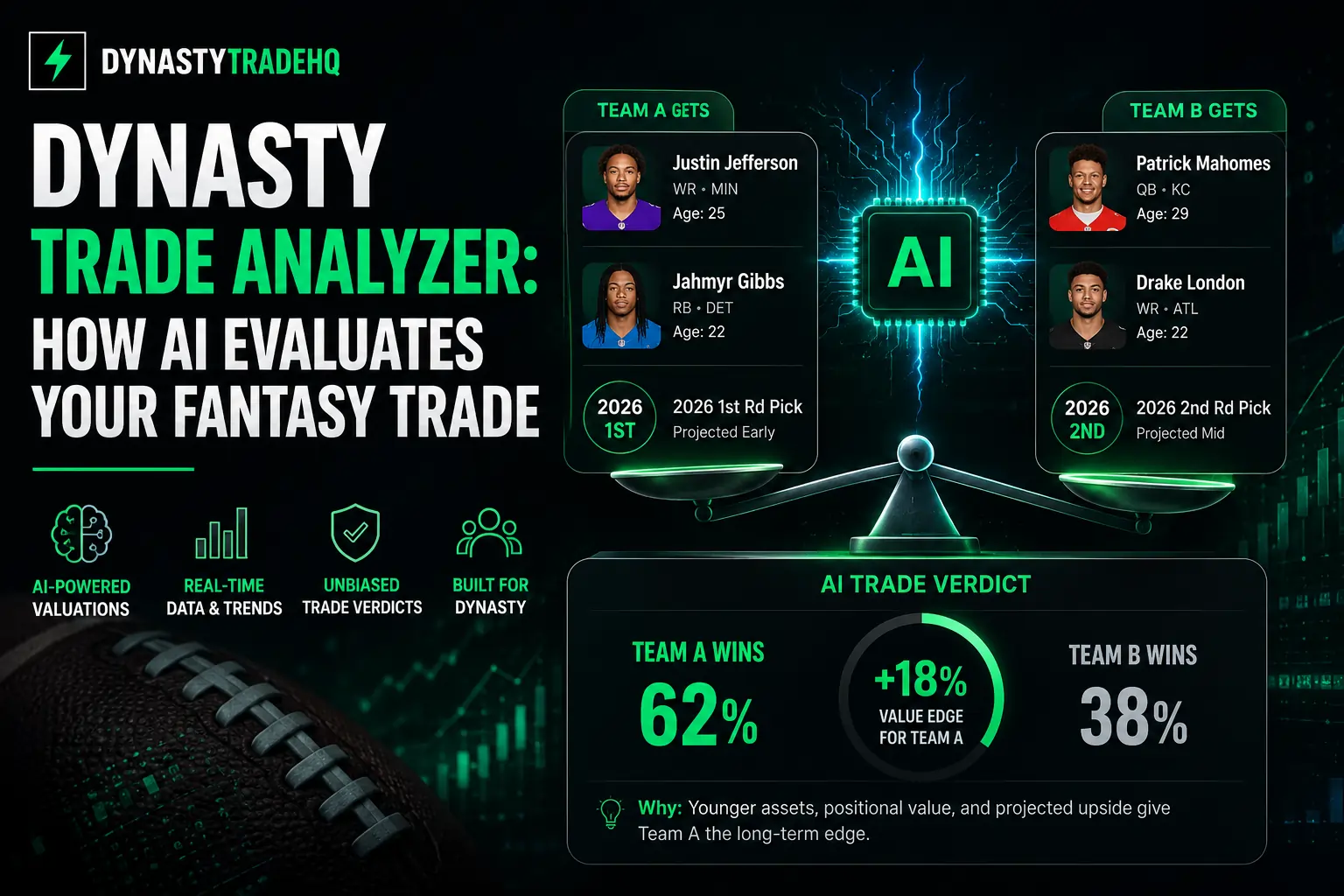
You have a trade offer sitting in your inbox, and your gut is split. That is exactly the problem a dynasty trade analyzer is designed to solve. This post breaks down how AI-powered trade analysis works under the hood, why it produces more consistent verdicts than intuition, and how to use one free right now at https://dynastytradehq.com.
Table of Contents
What Is a Dynasty Trade Analyzer?
A dynasty trade analyzer is a tool that compares the dynasty value of every player and pick in a proposed trade and returns a verdict on which side wins, by how much, and why. The term gets used loosely across the fantasy football community, but the core function is always the same: take two sides of a trade, run them through a valuation model, and surface the imbalance so you can negotiate or accept with confidence.
The key distinction between a basic trade calculator and an AI dynasty trade analyzer is what drives the valuation. A static calculator compares fixed-point values assigned to each player, values that age the moment they are entered. An AI-powered analyzer updates dynamically, weighing player values based on recent performance trends, injury news, target share shifts, and community trade activity across thousands of leagues. The result is a living valuation, not a snapshot.
For dynasty specifically, this matters more than in redraft. Dynasty trade value is sensitive to a player’s age, contract situation, team context, and projected trajectory over multiple seasons. A 25-year-old wide receiver coming off a slow start to the season holds more value than his current stats suggest. A 30-year-old running back on an expiring contract holds less. A static value chart cannot weigh those factors in real time. An AI model can.
When you run a trade through the DynastyTradeHQ analyzer, the tool surfaces a side-by-side value comparison, a win percentage for each side, and context on what is driving the gap. That context is what separates an AI verdict from a gut feeling: it is traceable, explainable, and consistent across every trade you evaluate.
How AI Models Evaluate Dynasty Player Value
Player valuation in a dynasty trade analyzer is not a single number pulled from a spreadsheet. It is a composite score built from multiple signals processed together. Understanding those signals helps you interpret AI verdicts more accurately instead of treating them as a black box. The core inputs most AI dynasty trade analyzers weigh include: age and expected peak window, positional scarcity within the current dynasty landscape, recent production and target volume, team situation and offensive role, and community trade data showing what managers are actually accepting in real leagues.
Each of these inputs carries a different weight depending on position. Age matters more for running backs than for quarterbacks. Target share matters more for wide receivers than for tight ends early in their careers. The AI layers these signals together and returns a value that reflects the player’s dynasty outlook, not just their last four games. This is why an AI verdict can diverge sharply from what you see in a simple trade value chart. The chart shows one number. The model shows a weighted probability of future output.
For dynasty draft picks, the same logic applies. A 2026 first-round pick carries a range of possible values depending on where the pick is expected to land. An AI analyzer accounts for that range and discounts the pick accordingly, rather than treating all first-rounders as equivalent. You can see how pick values interact with player values in the DynastyTradeHQ player values tool. Comparing them side by side before you run your trade gives you a baseline before the full analyzer surfaces the composite verdict.
Why AI Verdicts Beat Gut Feel in Dynasty Trades
Gut feel in dynasty fantasy football is not worthless. Experienced managers develop real pattern recognition over years of play. But gut feel has two structural weaknesses that AI analysis directly addresses. The first weakness is recency bias. Human evaluators overweight what happened in the last two or three weeks. A player who just posted back-to-back 20-point games feels untradeable, even if his dynasty trajectory is flat or declining. An AI model weights recent performance as one signal among many rather than as the dominant factor, producing a more stable valuation over time.
The second weakness is asymmetric information. In a dynasty trade, the manager selling a player usually knows more about that player’s situation than the manager buying. They have watched the film, tracked the snap counts, and noticed the target share creeping down. The buyer is often working from box scores and highlight clips. An AI analyzer closes that gap by processing the same underlying data that informs the seller’s decision, then surfacing it in the verdict. There is also a consistency argument. Human evaluators shift based on mood, league context, and what they need at the moment.
If you desperately need a wide receiver, you will unconsciously inflate the value of the receiver on offer. An AI analyzer does not have roster needs. It evaluates the trade in isolation, which is what a fair valuation requires. For a deeper look at the strategic layer that sits on top of any trade verdict, the DynastyTradeHQ guide covers how to act on AI analysis once you have it.
How to Use a Dynasty Trade Analyzer Free
Using the DynastyTradeHQ dynasty trade analyzer free takes less than two minutes. The workflow is straightforward: enter the players and picks for each side of the trade, run the model, and read the verdict. The process does not require an account or a subscription.
Here is the practical sequence most managers follow:
- Enter every asset on your side of the trade, including players, picks, and any add-ons.
- Enter every asset on the other side.
- Read the win percentage and value gap that the analyzer returns.
- Check the individual player values to understand what is driving the gap.
- Use the verdict as a starting point for negotiation, not a final decision.
That last point matters. The analyzer tells you which side of the trade wins based on dynasty value. It does not know your specific roster needs, your league’s scoring settings, or the depth at each position in your league. A trade that looks slightly negative in the analyzer might still make sense if it fills a critical positional hole before your playoff run. The AI gives you the valuation floor. The roster context is your layer to add.
The Dynasty football trade analyzer at DynastyTradeHQ is also free for unlimited trades. There is no paywall for the core analysis function, so you can run multiple versions of the same trade with different add-ons to find the adjustment that makes it fair.
What the Dynasty Trade Analyzer 2026 Accounts For
Dynasty trade values in 2026 are shaped by several factors that were not part of the landscape even two seasons ago. An AI dynasty trade analyzer 2026 model needs to account for these shifts to return accurate verdicts, and a static chart from a prior year simply cannot keep up.
The most significant factor is the continued compression of wide receiver peak windows. More receivers are producing at a high level earlier in their careers, which has shortened the dynasty premium on veteran receivers who would have held elite value five years ago. AI models trained on recent community trade data reflect this shift in real time. A static chart often lags by a full season.
Running back valuations have stabilized somewhat after the extreme discount era of the early 2020s, but committee backfields still suppress individual values in ways that require position-specific context for evaluation. An AI analyzer weighs backfield role data, not just touches, which matters enormously for dynasty.
Quarterback value in dynasty formats has also shifted. The gap between elite and replacement-level quarterbacks has narrowed in some scoring systems, which affects what you should pay in a trade. The DynastyTradeHQ QB rankings show the current dynasty tier structure if you want to map a quarterback’s rank before running a trade through the analyzer.
For reference, it walks through how these values compare against historical charts and where the AI model diverges from them.
Is the Dynasty Trade Analyzer Right for Every Trade?
Not every trade situation calls for the same depth of analysis. Some trades are so lopsided that the verdict is obvious before you open the tool. Others sit in a grey zone where the analyzer’s value gap is small enough that roster context, league scoring, and personal preference should carry the final decision.
The analyzer adds the most value in three specific scenarios. The first is when you are evaluating a player at a career inflection point: a receiver entering his age 27 season, a running back returning from a significant injury, or a quarterback changing teams. These transitions create genuine valuation uncertainty that AI models handle better than gut feel because they process multiple historical comps simultaneously.
The second scenario is when the trade involves draft picks mixed with players. A pick-plus-player package is notoriously difficult to value intuitively because the pick range adds a variable layer on top of the player comparison. The AI analyzer collapses that variable into a weighted expected value, which makes the comparison tractable.
The third scenario is when you are negotiating. A screenshot of the analyzer verdict is a neutral third-party reference point you can share with your trade partner. It removes the personal element from the negotiation and anchors both sides to the same valuation framework. That alone often closes trades faster. The fantasy football trade analyzer is free to use as many times as you need, so there is no cost to running the same trade three different ways before you reply to your league mate.
Is the DynastyTradeHQ Trade Analyzer Worth Using?
Yes, especially for trades that sit in the grey zone where gut feel and trade charts disagree. The AI model processes more signals than any static chart and updates faster than any manually maintained list of values. Run the trade, read the gap, and let the verdict anchor your negotiation. Stop negotiating blind: the AI verdict takes 60 seconds, and it is free.
Run Your Trade Through the Calculator
FAQs
What is a dynasty trade analyzer?
A dynasty trade analyzer is a tool that compares the value of every player and pick in a proposed trade and returns a verdict on which side wins and by how much. AI-powered versions update valuations dynamically based on performance trends, roster context, and real trade data from active dynasty leagues.
Is there a dynasty trade analyzer free to use?
Yes. The DynastyTradeHQ trade analyzer at dynastytradehq.com is free with no account required. You can run unlimited trades through the tool, compare individual player values, and get a side-by-side win percentage for both sides of any dynasty trade.
How accurate is an AI dynasty trade analyzer compared to a trade value chart?
An AI dynasty trade analyzer is more accurate than a static trade value chart for most trades because it dynamically weights current performance signals, age curves, and team context. Trade value charts reflect a fixed point in time. AI models update continuously based on what dynasty managers are actually accepting in real leagues.
How do I use a dynasty football trade analyzer before accepting an offer?
Enter every player and pick on both sides of the trade into the analyzer, then read the value gap and win percentage it returns. Use the verdict as your baseline, then layer in your roster needs and league context before deciding. For close trades, the gap between the two sides is your negotiating room.
