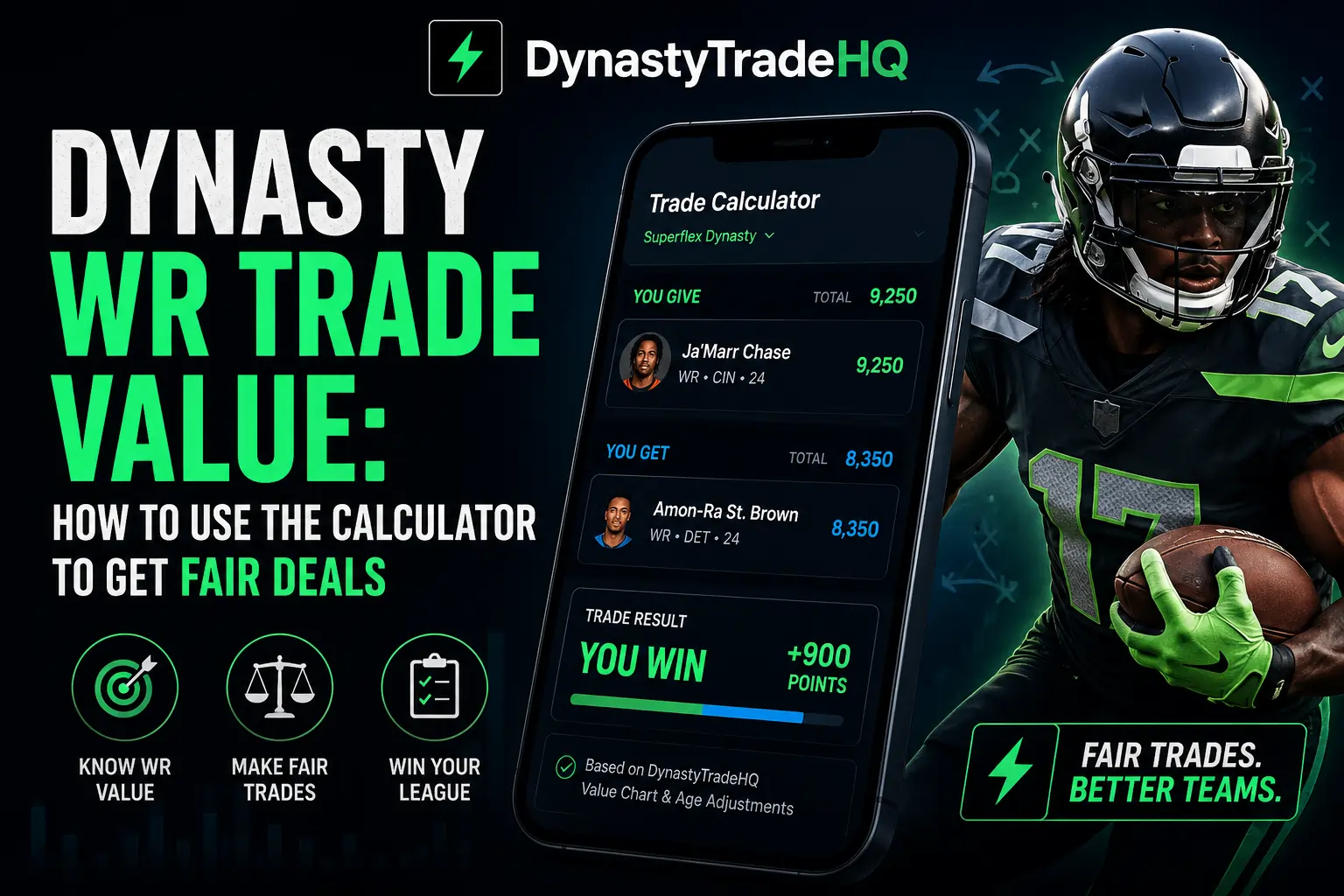
Wide receiver is the most traded position in dynasty leagues, and it is also the easiest position to get robbed at. Dynasty WR trade value shifts faster than most managers track, especially when age, injury, or a depth chart change hits. This post is not a player rankings list. It is a guide to reading WR value correctly and using the DynastyTradeHQ trade calculator to make sure what you are getting is actually worth what you are giving up.
Table of Contents
Why WR Value in Dynasty Works Differently Than Redraft
Dynasty WR trade value and redraft WR value are measuring two completely different things. In redraft, a receiver is worth what he scores this season. In dynasty, a receiver is worth what he produces across a 3 to 5 year window, discounted by age and injury risk. A 29-year-old WR1 who just had a career year looks great in a trade offer. But dynasty value accounts for the back half of his career, which has a steep drop-off probability starting around age 30 for most receiver archetypes.
A younger WR2 with a rising target share on a good offense often carries more dynasty trade value than the older WR1, even though the older player is producing more right now. This is exactly where managers get taken advantage of in trades. The other manager is thinking in dynasty terms. You are thinking in redraft terms. You end up giving up a 24-year-old WR2 for a 30-year-old WR1 and feeling good about it until year two.
The DynastyTradeHQ calculator builds age into its value model. When you plug in two sides of a trade, the tool is not just comparing production; it is comparing the expected value of each player over a realistic dynasty horizon. That is the lens you need when evaluating WRs specifically, because the position’s age curve is punishing enough that ignoring it costs you real assets. Before you agree to any WR-heavy trade, check the trade calculator. It takes 30 seconds and can save you from a deal that looks even but is not.
The Four WR Value Tiers You Need to Know
Not all WRs are worth the same kind of trade currency, and trading within tiers versus across tiers leads to very different outcomes. Understanding how WR value stacks gives you a negotiating framework.
Tier 1: Locked-In WR1s
These are receivers who sit at the top of dynasty trade value charts regardless of season. They have elite target share, proven quarterbacks, and the age profile to sustain production. Trading for a Tier 1 receiver costs a significant package. The calculator will reflect this with a clear imbalance if you are underpaying.
Tier 2: Rising WR2s With Upside
This is where the best value trades happen. A WR2 in a strong situation who is 23 or 24 years old is likely to enter Tier 1 by his peak seasons. Managers who are rebuilding may sell him short. Managers who are contending may ignore him because he is not a WR1 yet. Buying here, confirmed by the trade calculator, is how you acquire value at a discount.
Tier 3: Boom-or-Bust Profiles
These are receivers with elite upside but meaningful risk. That could be injury history, quarterback uncertainty, or inconsistent usage. Their trade value is volatile, which means you can buy low right after a bad week and sell high after a good one. The calculator helps you identify whether the current market is inflating or deflating their value versus what the model expects.
Tier 4: Fading Veterans
Receivers on the wrong side of 30 who are no longer producing at WR1 levels. Their name brand often exceeds their actual dynasty trade value. Managers sell these when they can still get something back. If the calculator shows a trade is even, but one side is filled with Tier 4 receivers, walk away.
How to Actually Use the Calculator for WR Trades
Open the trade calculator at https://dynastytradehq.com and enter both sides of a proposed trade exactly as presented. Include every piece on both sides. Do not leave out a player because you think he is irrelevant. Then look at three things before making your decision. First, check the overall point differential. The calculator will show you which side is winning the trade by value. A trade that comes back within a few points is fair. A trade that shows a 20 or 30-point gap means someone is giving up real assets.
Second, check whether the calculator agrees with your read on each player. If a receiver you want to buy is valued lower than you expected, that is useful information. It means the market has not priced in the upside you see, which is either a buying opportunity or a signal that the community knows something about his situation that you have not fully weighed.
Third, look at what the calculator shows for the player you are giving up. Managers consistently undervalue what they already own. The familiarity discount is real. You have watched your WR2 disappoint you this season, so you are eager to move him. But if the calculator shows he is worth significantly more than what is coming back, your frustration is clouding the evaluation. The calculator removes emotion from the equation. That is its most underrated function.
Where WR Age Makes Trades Go Wrong
Age is the most common variable that causes managers to misjudge dynasty WR trade value. Most dynasty trade tools, including ours, incorporate age into their value model because the NFL data on receiver aging curves is consistent enough to build around. Wide receivers typically peak in production somewhere between ages 24 and 27. After 28, the decline is gradual. After 30, it accelerates. This does not mean a 31-year-old receiver has no value, but it means his dynasty trade value is discounted relative to his current production because the remaining runway is short.
When you are being offered a 30-year-old WR1, you are buying one or two more productive seasons at most. When you are being asked to give up a 24-year-old WR2, you are selling four to five peak seasons. Those are not equivalent trades even if the current production numbers look close. The calculator reflects this. If you enter an older WR1 against a younger WR2, you will often see the younger player rated higher or the trade closer than you expected.
That output is not a bug. It is the model telling you that age-adjusted value does not match the eye test. You can cross-reference the calculator against the full dynasty WR rankings to see where each receiver sits across the broader pool before you commit to a deal.
Superflex vs. Standard: How Format Changes WR Value
Dynasty WR trade value is not constant across formats. The format your league uses changes how you should price receivers in trades, and the DynastyTradeHQ calculator accounts for this. In standard dynasty leagues with one quarterback slot, wide receivers are the premium position. WR1 trade value is high because the passing game is the engine of scoring. The top receivers command significant returns in trades.
In Superflex leagues, the dynamic shifts. Quarterbacks absorb some of the premium that WRs hold in standard formats. This does not reduce WR value entirely, but it changes the relative cost of acquiring a top receiver. You are competing for fewer quarterback spots, so teams are less willing to sell QBs, which means WR trades become a larger portion of roster-building activity.
The practical implication is straightforward. If you run a Superflex league, make sure you are using the Superflex calculator rather than the standard version. Running a WR trade through the wrong calculator format will give you a skewed read on whether the deal is fair. This is one of the most common errors managers make when trying to assess dynasty WR trade value using generic trade tools. Format-adjusted values matter, and the calculator separates them.
Is This WR Trade Worth It? Here Is the Bottom Line
Dynasty WR trade value comes down to three things: age, role, and format. If you are eyeballing a trade without checking the calculator, you are guessing. Run every WR trade you are considering through the tool before you send or accept an offer, especially in trades where both sides include multiple pieces. Stop guessing on WR value before you accept or send a trade offer.
Run Your Trade Through the Calculator
FAQs
What is dynasty WR trade value?
Dynasty WR trade value is a score that reflects how much a wide receiver is worth in a trade relative to other players, adjusted for age, role, and expected production over multiple seasons, not just the current year. A calculator gives you this number in seconds so you can compare both sides of any deal.
How do I know if I am getting fair value for a wide receiver in dynasty?
Run both sides of the trade through a dynasty trade calculator. Fair value means the point totals on each side are close. If the calculator shows a significant gap in your opponent’s favor, the trade is not even, regardless of how balanced it looks on paper.
Does receiver age matter in dynasty trade value?
Yes. Receivers over 29 are discounted in dynasty trade value because their remaining productive seasons are limited. A younger WR2 will often grade out higher than an older WR1 in a dynasty calculator because the model accounts for long-term output, not just current production.
Should I use a different calculator for Superflex dynasty leagues?
Yes. Superflex formats change the relative value of every position, including wide receivers. Use a Superflex-specific calculator so your WR trade values reflect how your league actually scores players. Using a standard calculator in a Superflex league will give you inaccurate trade reads.
