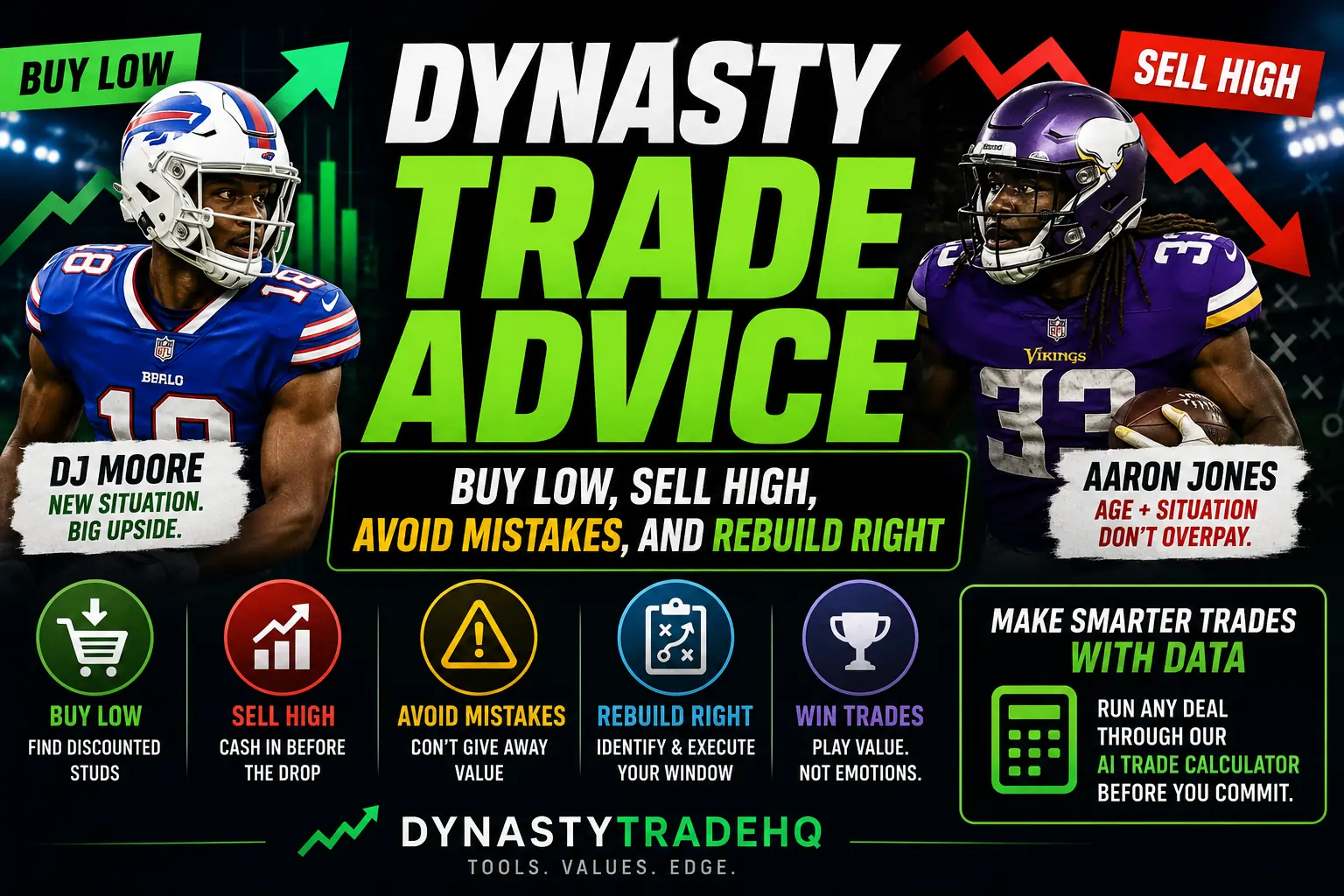
Every dynasty manager has felt it: the trade sits in your inbox, the deadline is ticking, and you are not sure if you are the one getting played. This guide is the single resource for dynasty trade advice, covering the buy-low and sell-high frameworks, the five mistakes that cost managers the most, and exactly how to identify your rebuild window and execute it. Run the numbers on any deal at the trade calculator before you finish reading, and come back to this page before every major move.
Table of Contents
The Buy-Low Framework: How to Identify Real Value Before Anyone Else Does
A buy-low target is a player whose dynasty value has dropped due to a slump, a situation change, or short-term noise rather than a permanent skill decline. That distinction is the entire game. You are not looking for broken players. You are looking for players that the market has mispriced due to a temporary factor.
The best buy-low windows open right after a few quiet weeks in a row, a late-season injury, a backfield change, or a receiver landing on a new team. The market reacts emotionally. Managers who held the player all season are frustrated and ready to sell at the worst possible moment, which is your opportunity.
DJ Moore is a textbook example. After a down 2025 season in Chicago, where he had 50 catches for 682 yards on just 85 targets, his dynasty value fell sharply. Managers sold into frustration. Then he was traded to the Buffalo Bills in March 2026, where he became Josh Allen’s clear WR1 ahead of Khalil Shakir and Joshua Palmer. His consensus dynasty ranking surged nearly 20 spots at the time of the trade. Managers who bought when he was buried in Chicago’s crowded receiver room captured that entire value swing.
The buy-low checklist for any player:
- The player has a clear production track record before the current slump
- The reason for the drop is situational, not physical decline or age erosion
- The player is 27 or younger, or showing pass-catching value if they are an older back
- You can acquire them for roughly 70 cents on the dollar versus their peak value
Before you approach a trade partner, run the current asset values through our AI verdict calculator so you know the floor you are working with. Knowing the market number gives you a negotiating edge and prevents you from accidentally overpaying even on a discounted asset.
One structural trap to avoid: targeting a player without a realistic path back to targets or carries. A buy-low only pays off if the situation is corrected. Confirm the upside scenario is plausible before you approach the trade partner.
The Sell-High Framework: Knowing When to Cash In Before the Market Corrects
Selling high is psychologically harder than buying low. The player just had a great stretch, the league chat is buzzing, and every instinct says to hold. That instinct is usually wrong.
A sell-high target is a player currently performing at or near the ceiling of what their situation can realistically sustain. If a running back just had a five-touchdown month due to red-zone volume and an injured starter above them, the market is treating a spike as a trend. You sell into that gap before it closes.
The most reliable sell-high signals: a spike in touchdown rate well above career norms, a breakout that required a starter’s injury to happen, a receiver hitting career highs in a contract year, or a young player with strong buzz but a crowded depth chart blocking long-term volume.
Use the player values page to see where a player sits right now versus three months ago. A sharp upward move in market value is your green light to field offers. If managers who ignored that player last month are suddenly sliding him into every trade offer, that is the window closing.
Sell-high does not mean dumping players for pennies. It means identifying the gap between current market perception and true sustainable value, then closing that gap through a trade before the correction happens on its own.
One timing rule worth following: the optimal sell window is 1 to 2 weeks after the big game or a notable change in circumstances. That is when competing managers feel the most urgency and are most likely to overpay.
The Five Common Dynasty Trade Mistakes That Cost Managers Wins
Most dynasty losses are not caused by bad luck. They are caused by predictable, repeatable mistakes. Recognizing them is the first step to stopping them.
Mistake 1: Paying for age at the wrong position. Running backs lose dynasty value faster than any other skill position. Back on a one-year restructured deal entering his age-32 season is a redraft play, not a dynasty asset. Aaron Jones illustrates this clearly. After restructuring his contract to stay with the Vikings for 2026, Jones enters his age-32 season, splitting carries with Jordan Mason. His remaining dynasty value is limited to PPR pass-catching, and even that trajectory is declining. The rookie you pass on to acquire Jones almost always returns more long-term value.
Mistake 2: Selling off a rebuild too early. Flipping young assets the moment a season goes sideways often leaves you holding the wrong side of a trade six months later. If your window is closed, sell veterans for picks and youth. But do not trade a 24-year-old receiver for a 29-year-old closer and a mid-round pick. That is rebuilding in reverse.
Mistake 3: Ignoring team context. Player value in dynasty is inseparable from the offense around them. A receiver moving from a dysfunctional passing attack to a pass-heavy system is not the same asset. Always check the depth chart, usage role, and offensive philosophy before assigning value.
Mistake 4: Trading from emotion after a bad week. Most managers who blow up their roster in week 10 regret it by January. Check the dynasty rankings before deciding anything is broken.
Mistake 5: Over-investing in quarterbacks in single-QB leagues. Unless you are in a superflex or 2QB format, the quarterback carries the least dynasty trade value of any position. That capital belongs to the receiver and running back.
When to Rebuild: Reading the Signals Before It Is Too Late
The decision to rebuild is one of the hardest calls in the dynasty because it requires admitting the current roster cannot compete. Most managers make that admission one season too late.
The rebuild signal is not a losing record. It is a losing record, combined with aging core assets and no incoming draft capital to fix it. If your top three players are all 28 or older, your next two years of picks are late-round selections, and your roster has no young player with a clear path to a starting role, you are in rebuilding territory right now.
Smart managers start rebuilding one year before it becomes obvious. That lead time is the difference between selling veterans near peak value and being forced to sell at a discount to buyers who already know your window is closed.
Specific triggers to watch for:
- Your franchise quarterback is 32 or older with no heir on the roster
- Your top running back is over 29 and showing role erosion
- You have not drafted a wide receiver inside the top 50 picks in any of the last three rookie drafts
- Your roster skews toward players with two to four years of remaining value rather than six to eight
One rebuild trap to avoid: moving every asset at once. A controlled rebuild staggers the sale over two off-seasons. That keeps the team credible enough in the trade market to avoid being lowballed by managers who see a fire sale coming.
How to Rebuild: The Step-by-Step Process for Resetting Your Roster
Knowing you need to rebuild and knowing how to execute one are different skills. Here is the process that actually produces contenders on the other side.
Step 1: Audit your roster by age and value timeline. Sort every player into three buckets: build-around assets for six or more years, tradeable assets with two to four years of value, and redraft-only assets. The third bucket is your immediate sell list.
Step 2: Prioritize picks over player-for-player swaps when dealing veterans. A first-round rookie pick in a deep dynasty league carries more long-term upside than a safe RB2 who is 28. Stack early picks above everything else.
Step 3: Target young players with proven target share or backfield roles on contending rosters. Managers with a championship window undervalue youth. A 22-year-old WR2 on a win-now team is often available for a veteran who fits their immediate window.
Step 4: Not every pick trade is equal. A first from a losing team is worth more than a first from a perennial contender. Know the likely landing range before accepting deferred capital.
Step 5: Once two or three young cornerstones are in place, add one win-now piece in year two. Managers who go completely dark lose trade leverage.
Use the general dynasty rankings at and the positional rankings at to identify which younger players belong in your rebuild core before you approach anyone with an offer.
Is Your Dynasty Trade Actually Fair? How to Know Before You Accept
Checking a trade at the calculator is not optional. It is the fastest way to confirm whether the deal that feels right actually is right.
A fair trade is one where the market value of assets moving in both directions is within ten to fifteen percent of each other, with appropriate adjustments for age trajectory, positional scarcity, and team situation. Raw numbers tell you the baseline. Situational context tells you whether those numbers need to move.
Before accepting any deal, ask three questions. First, who gets the better age profile? If you are receiving players two or three years older than those you are giving up, you need a meaningful premium in return. Second, does this trade move your roster closer to a realistic championship window? Collecting assets is not a strategy. Collecting the right assets for your timeline is. Third, if you reverse the trade entirely, would you feel good about your opponent getting your side? If the answer is no, it is probably a bad deal.
Process is what separates winning managers from the rest. Before you respond to the next offer in your inbox, run both sides through the dedicated calculator. Two minutes of due diligence will save you from the trade you regret for three seasons.
Every trade you make without checking the data is a trade you might regret. Before you accept or send that offer, get the numbers in your corner.
Run Your Trade Through the Calculator
FAQs
What is the best dynasty trade advice for beginners?
Separate player value from player attachment. Beginners overpay for players they own and underpay for players they want. Anchor every negotiation to a trade calculator and always verify age and team situation before accepting any offer.
How do I find buy-low targets in dynasty fantasy football?
Target players whose value dropped due to short-term noise, not permanent decline. Look for quiet stretches, recent trades, or backfield changes with a clear path back to production. Cross-reference the current value against the value six months ago to confirm the discount.
When should I start a dynasty rebuild?
Start when your top three players are 28 or older, incoming picks are late-round, and no young players have a clear path to a starting role. Begin one season before it becomes obvious, or you will sell at a discount.
How do you know if a dynasty trade is fair?
Market value on both sides should be within ten to fifteen percent of each other. Use a trade calculator to set the baseline, then adjust for the age trajectory, depth-chart position, and team situation before making a decision.
