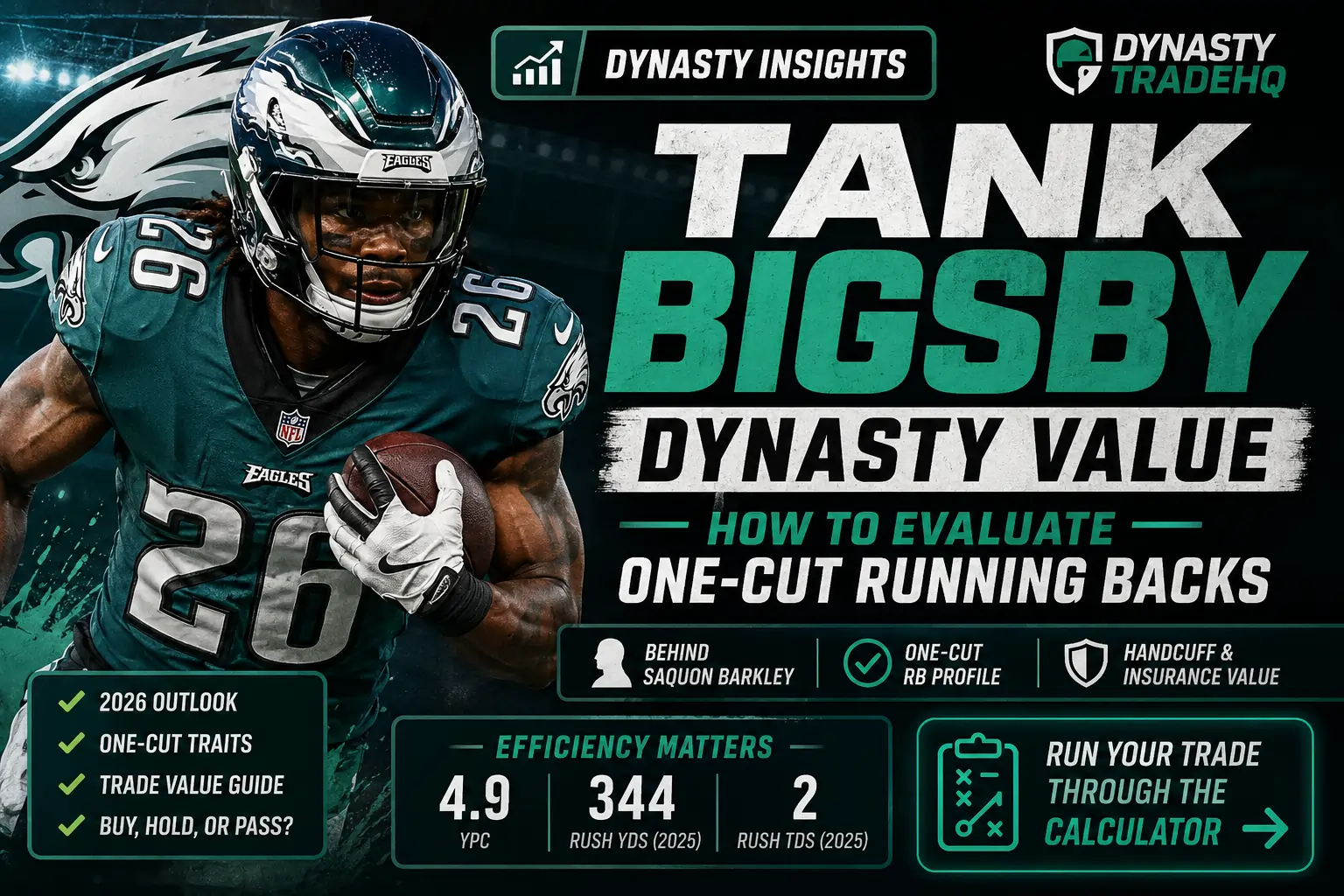
Tank Bigsby dynasty value has shifted since his surprise trade out of Jacksonville, and most rankings still treat him like a Jaguars committee back instead of Saquon Barkley’s direct backup in Philadelphia. Evaluating a player like Bigsby means understanding what a one-cut running back actually is and how that skill set translates behind an entrenched starter. This piece breaks down the one-cut framework, walks through Bigsby’s current role, and tells you exactly where his dynasty value sits heading into 2026.
Table of Contents
What Makes a Running Back a One-Cut Prospect
A one-cut running back is a ball carrier who reads the blocking scheme once, plants his foot, and accelerates through a single gap instead of dancing laterally or bouncing outside. This style depends on vision, patience, and decisiveness rather than pure speed or power. Zone blocking teams value this trait because it keeps the offensive line’s assignments clean and turns small creases into positive yardage instead of negative plays.
Evaluating a one-cut back in dynasty leagues means looking past raw touch totals. Yards per carry, missed tackles forced, and efficiency in a limited sample tell you more about the skill set than a workhorse’s counting stats ever could. A back who averages close to five yards per carry on a handful of touches every week is showing the exact traits that translate into a bigger role if the opportunity ever opens up.
The tradeoff is opportunity itself. A one-cut back can be highly efficient and still carry limited standalone fantasy value if he is stuck behind an entrenched starter. That is the exact situation dynasty managers need to evaluate with Tank Bigsby, whose efficiency numbers have been strong but whose touch share has been dictated entirely by the player in front of him on the depth chart.
Before deciding whether a player like this fits your roster, run the numbers on this trade and see how his value compares to what you would give up to acquire him. A one-cut evaluation only matters if the acquisition price reflects the risk of a backup role, not the upside of a starter.
Tank Bigsby’s Trade From Jacksonville to Philadelphia
Bigsby’s situation changed permanently in September 2025, when the Jacksonville Jaguars traded him to the Philadelphia Eagles for a fifth and sixth-round pick. Jacksonville’s backfield had become crowded that offseason after the team drafted two rookie running backs, Bhayshul Tuten and LeQuint Allen Jr., making Bigsby the odd man out, even though he had been productive in a rotational role behind Travis Etienne.
The move sent Bigsby from a crowded, undefined committee into a clearly structured depth chart behind Saquon Barkley. He played 16 games for Philadelphia in 2025, recording 58 carries for 344 yards and two touchdowns while adding three catches for 32 yards. His only start came in Week 18, a game Barkley sat out to rest, and Bigsby responded with 75 rushing yards, a touchdown, and a 31-yard catch on 16 carries.
That performance matters for dynasty evaluation because it is the clearest available sample of what Bigsby looks like under a real workload. He averaged 4.7 yards per carry in that start and has posted 4.9 yards per carry over his last two NFL seasons combined. Those are one-cut-back numbers, efficient and decisive, even in a limited sample.
Where Bigsby Fits on the Eagles Depth Chart in 2026
Saquon Barkley is entering his age-29 season after back-to-back years with heavy workloads in Philadelphia, including a historic 2024 campaign of 2,005 yards and 13 touchdowns, followed by a down 2025 season of 1,140 yards and 7 touchdowns on 280 carries at 4.1 yards per carry. New offensive coordinator Sean Mannion is installing a wide-zone scheme under center for 2026, a system Barkley has publicly embraced and one that fits Bigsby’s one-cut skill set well.
Philadelphia’s offensive line remains one of the stronger units in the league, which raises the ceiling for any back who steps into a starting role behind it. If Barkley were to miss extended time, Bigsby would immediately become a must-start dynasty option given his proven efficiency and his familiarity with the scheme after a full season in the building.
Will Shipley is also on the Eagles roster and provides competition for the backup role, primarily as a pass-catcher and return specialist. Bigsby’s edge over Shipley is his efficiency as a between-the-tackles runner, which fits the new wide-zone scheme more directly. Kick return duties have moved to other players, confirming Bigsby’s role is strictly a rushing and change-of-pace function.
Dynasty managers should treat him purely as a handcuff and insurance piece rather than a player carving out a separate package of touches. His current path to fantasy relevance runs entirely through a Barkley injury, which narrows his weekly value but sharpens exactly what dynasty managers are paying for when they acquire him.
Tank Bigsby Dynasty Value: What the One-Cut Framework Tells Us
Applying the one-cut framework to Bigsby’s tape supports the same conclusion his stats suggest. He reads zone blocking schemes well, gets north and south quickly, and does not lose yardage trying to bounce runs outside the tackles. Those traits matter more in Philadelphia’s new Mannion-led scheme than raw explosiveness would, and they explain why he has stayed efficient despite an inconsistent workload.
Dynasty rankings currently place Bigsby outside the RB60 range in most formats, largely because his role is capped by Barkley’s health rather than his own limitations. That is a normal outcome for a one-cut back stuck as a direct backup, and it means his value should be evaluated against other high-end handcuffs rather than against every running back on the board.
The efficiency profile is what separates a worthwhile stash from a roster filler. A back averaging under four yards per carry behind a workhorse starter is not worth a bench spot in most dynasty formats. Bigsby’s near five-yard per carry average over two seasons puts him firmly in the stash category for managers who already roster Barkley or want cheap insurance in deeper leagues.
Check where Bigsby ranks against other backup running backs at player values before deciding how much draft capital or trade value he is worth in your league.
Buy, Hold, or Pass on Bigsby in Dynasty Leagues
Bigsby fits best as a buy for managers who already roster Saquon Barkley and want built-in insurance at a low cost. His trade value is unlikely to spike unless Barkley suffers an injury, which makes him a patient hold rather than a player to chase at a premium price right now.
One additional factor worth noting heading into 2026: Barkley is entering his age-29 season on the back of a down year and a heavy multi-season workload. That age-and-usage curve introduces real durability uncertainty that did not exist a year ago, slightly raising Bigsby’s floor as a dynasty asset compared to prior seasons.
Redraft managers should mostly avoid him outside of deep leagues, since his weekly floor depends entirely on Barkley’s availability. Dynasty managers operate on a longer timeline, and that timeline favors rostering efficient one-cut backs like Bigsby even when their current role looks limited on paper.
For managers who do not already have a Barkley investment, Bigsby is a pass in most single RB or shallow bench formats. The opportunity cost of a roster spot is too high when better speculative upside exists elsewhere. Superflex and deep dynasty leagues are the exception, where his efficiency and clear role behind a workhorse make him a reasonable final bench spot.
The right price for Bigsby is a late startup pick or a throw-in piece on a larger deal, not a significant standalone asset.
Is Tank Bigsby Worth a Roster Spot in Dynasty Leagues?
Bigsby is worth a bench spot in most dynasty formats if you already roster Saquon Barkley or play in a league that rewards efficient handcuffs. His one-cut skill set and near five-yard per carry average make him a quality insurance piece, even though his standalone value stays capped until Barkley’s workload changes. Barkley, entering his age-29 season on a heavy usage history, adds a layer of legitimacy to Bigsby’s roster candidacy that was not there a year ago. Treat him as a patient hold, not a player to overpay for today.
See exactly what Tank Bigsby is worth in your league’s format before you make a move. Run Your Trade Through the Calculator
FAQs
What is Tank Bigsby’s dynasty value in 2026?
Tank Bigsby’s dynasty value is that of a high-end handcuff behind Saquon Barkley, not a standalone starter. He only carries weekly upside if Barkley misses time, and his near five-yard per carry average makes him a worthwhile bench stash. Barkley, entering his age-29 season with a history of heavy workloads, adds modest upside to Bigsby’s dynasty candidacy.
Why was Tank Bigsby traded to the Eagles?
Tank Bigsby was traded to the Eagles in September 2025 after Jacksonville drafted two rookie running backs and crowded the backfield. Jacksonville received a fifth and sixth-round pick, and Bigsby became Saquon Barkley’s primary backup for the rest of the season.
What does one-cut mean for a running back?
One-cut describes a running back who reads the blocking scheme once, plants, and accelerates through a single lane instead of bouncing laterally. This style relies on vision and decisiveness rather than power, and it fits zone blocking schemes especially well.
Should I roster Tank Bigsby in dynasty leagues?
Roster Tank Bigsby if you already own Saquon Barkley or play in a deep enough league to value efficient handcuffs. His role stays capped while Barkley is healthy, making him a patient bench hold rather than a player worth trading significant capital for.
