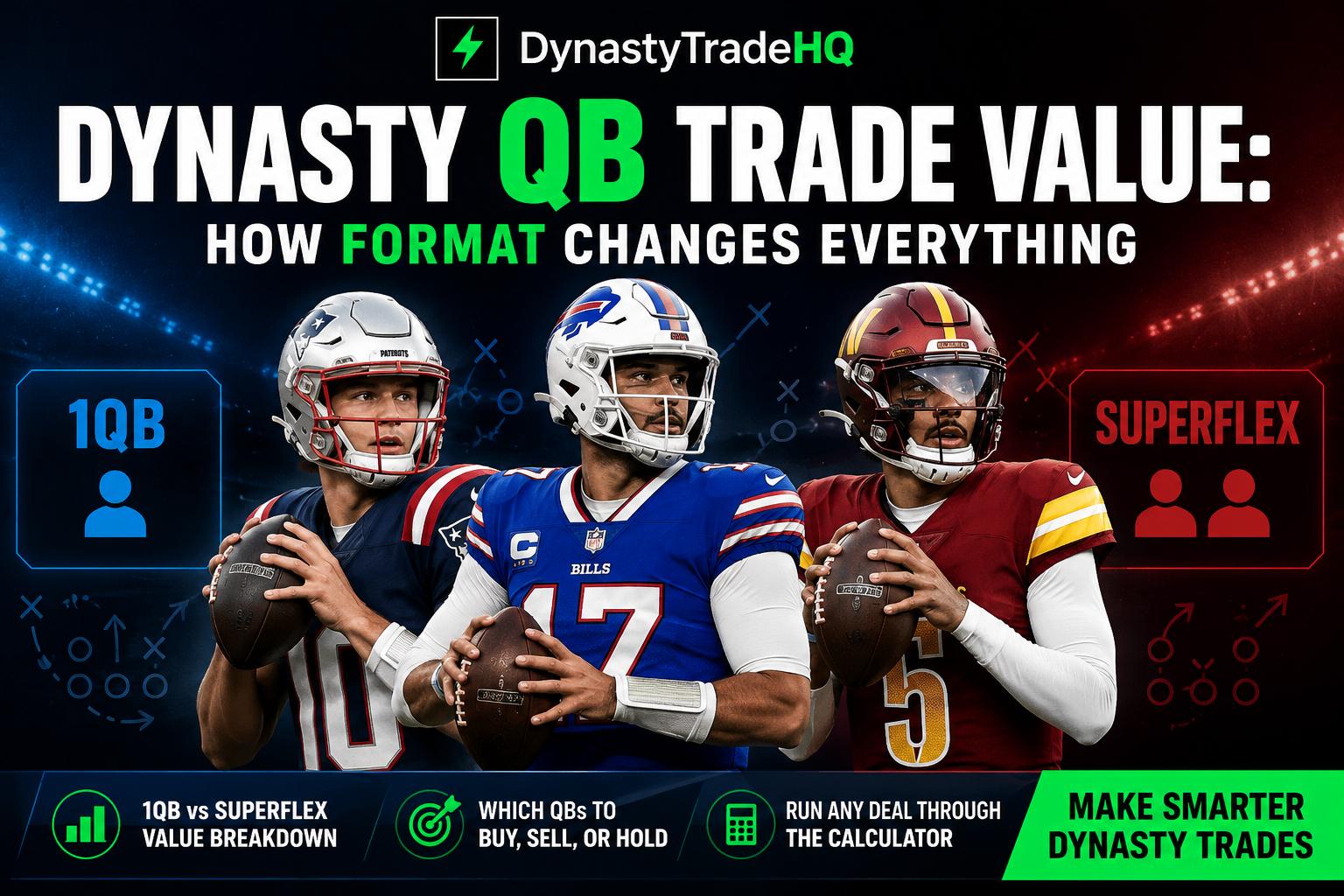
Quarterback value in dynasty is not a single number. It is two completely different markets depending on whether your league starts one quarterback or allows a Superflex roster spot. Before you accept or reject any QB trade, you need to know which version of dynasty QB trade value actually applies to your league. This guide breaks down how to price quarterbacks in both formats and how to use the trade calculator at https://dynastytradehq.com to make sure neither side of your deal is wildly off.
Table of Contents
How Format Defines Dynasty QB Trade Value
Dynasty QB trade value is the price the market assigns to a quarterback as a long-term roster asset, factoring in age, production, and how many years of elite starts remain. That base concept is consistent across formats. What changes dramatically is how scarce the position actually is in your league.
In a 1QB league, you only need one starting quarterback. Every roster has one, and the player pool can support that demand comfortably. A solid starter like Justin Herbert or Jayden Daniels is genuinely available at a fair cost because the market is not starved for the position. Elite quarterbacks like Josh Allen carry real value, but not so much that they outrank the best skill players on the board.
In a Superflex league, you can start a second quarterback in the flex spot. That single roster rule doubles the demand for starting-caliber quarterbacks across a 12-team league. Suddenly the position is scarce. A quarterback who would cost a mid-second-round pick in 1QB can cost a late first in Superflex because his competition for that roster spot is a wide receiver or running back, not another quarterback.
The practical implication is this: a trade that is fair in one format can be completely lopsided in the other. If you are shopping a quarterback without specifying format in your calculator, you are working with the wrong number. Always set the format toggle before running any QB trade through our tool. The format gap tends to be widest in the middle tier of quarterbacks. Elite starters command a premium in both formats. It is the QB8 through QB16 range where the format difference in valuation is sharpest, and where most trade mistakes happen.
The Elite Tier: Josh Allen, Drake Maye, and the Format-Proof Assets
Some quarterbacks carry dominant dynasty value regardless of format. Josh Allen is the clearest example. He has ranked among the top three fantasy quarterbacks in points per game for five consecutive seasons and currently goes first overall in most Superflex startups. In 1QB leagues, he still commands first-round startup capital, though the gap between him and the skill position options above him narrows considerably. Drake Maye enters 2026 as one of the most discussed dynasty assets at the position. His rookie season showed genuine top-end passing ability, and the age profile puts his peak squarely in the middle of a dynasty window.
In Superflex, he is argued as a rival to Allen at the top. In 1QB, he still goes in the first round, but the ceiling argument carries less leverage because the positional scarcity is simply not there. Lamar Jackson and Caleb Williams sit in a tier just below those two in most current dynasty consensus rankings. Jackson, at 29, carries a value that analysts are beginning to treat as capped.
He is still a round-one startup asset, but the dynasty community increasingly views him as a player to move while the market still prices him near his peak. Williams is rising. His first season under the Ben Johnson offensive system in Chicago generated growing confidence in his upside, and his cost is not going down heading into fall. The key point for trading this tier: format does not flip the hierarchy here, but it does affect return. An Allen trade that nets two first-round picks in Superflex might only net one and a second in a 1QB league. The player is the same. The format is not.
The Middle Tier: Where Format Splits the Market
Jalen Hurts, Joe Burrow, and Jayden Daniels represent the second tier of dynasty quarterbacks in 2026. In Superflex leagues, this group commands genuinely significant capital because any of them can start at the flex spot and win you a week. In 1QB leagues, they are still starter-quality assets but the return when selling drops.
Jaxson Dart is the most interesting case in this tier right now. He posted QB1-range production as a rookie with the Giants under John Harbaugh and has pushed into the top nine at the position in startup drafts. In Superflex, the ceiling argument is easy to make because young quarterbacks with rushing upside are uniquely valuable when the position starts twice per roster. In 1QB, the concussion history from his rookie year becomes a bigger conversation because if he misses time, a 1QB roster can absorb the loss more easily. He is not a bust call, but the format premium on him in Superflex is real.
Patrick Mahomes sits in a complicated spot as of mid-2026. He tore his ACL and LCL late in the 2025 season and is expected to begin 2026 on the PUP list. In a 1QB league, the injury risk on a 30-year-old quarterback coming off that timeline makes him a sell or a hold at best, depending on your roster window. In Superflex, the same logic applies, but managers trying to fill two quarterback spots are less willing to part with him on the cheap, which can inflate his trade return even while the actual risk is elevated.
Trading the Middle Tier
If you are selling a middle-tier quarterback in Superflex, the return should reflect real positional scarcity. A Burrow or Daniels trade should involve starter-level compensation on the other side. In 1QB, you are moving a position player who can be replaced more easily. Price accordingly and use format-specific values at https://dynastytradehq.com before you engage on a deal.
Selling a QB in 1QB vs Superflex: The Return Gap
The format gap matters most when you are the one initiating a sell. Managers who do not understand how their league’s format affects quarterback pricing consistently leave value behind when trading at the position.
In a Superflex league, a starting-caliber quarterback generates leverage you do not have in 1QB. If you own two QB1-range starters, the second quarterback on your roster has the same lineup value as a top wide receiver or running back. That is your trade asset. A manager in a Superflex league who needs to upgrade at quarterback will pay wide-receiver or running-back pricing for a dependable starter. That transaction almost never happens in 1QB, where a middle-tier quarterback moves for quarterback compensation or mixed packages at a discount.
Practical sell targets in Superflex right now include older elite quarterbacks who still command near-peak prices. Jackson in particular has been flagged by multiple analysts as a player whose dynasty value is capped at his current age. If you can move him for an elite wide receiver under 26 or a package anchored by young skill players, the surplus value tends to favor the quarterback seller in Superflex because the buyer is paying for starting lineup necessity.
In 1QB, the calculation reverses. Buyers are not desperate for the position. If you are trying to sell a 29-year-old quarterback in 1QB, expect to either take a slight discount or pair him with a pick to get full receiver value back. The rule of thumb: in Superflex, sell quarterbacks like skill positions. In 1QB, sell them like quarterbacks.
Buying a QB in 1QB vs Superflex: When Timing Matters
For a deeper look at the specific timing triggers around buying a quarterback, the post at the When to trade for a QB dynasty guide covers the age curves and windows in detail. The format-specific angle here is about what you are actually paying.
In Superflex, buying an elite quarterback at or near market rate is almost always justified if your roster lacks one. The position is too scarce to leave the spot uncovered. Managers who try to get cute and underpay on Superflex quarterback acquisitions routinely find no one is willing to sell below fair value because the buyer pool is large and competition for those assets is real.
In 1QB, you have more leverage as a buyer. Quarterbacks outside the top five are more available, sellers have fewer alternative buyers, and you can push for a discount on a quarterback with a soft stretch of production or a recent injury. The buy-low window on quarterbacks is materially wider in 1QB formats.
The timing rule across both formats: buy quarterbacks before the season. Dynasty QB trade value tends to rise as a player posts regular-season production. A quarterback who looks like a 1QB QB2 or a Superflex QB1 entering the season will cost more by Week 6 if he starts that way. The offseason is when format-adjusted pricing is most likely to work in your favor as a buyer. Young quarterbacks with rushing upside, specifically Drake Maye, Caleb Williams, Jayden Daniels, and Jaxson Dart, are positioned to appreciate regardless of format. Buying any of them before September is the lowest-risk version of that trade.
How to Use the Calculator for Format-Specific QB Trades
Running a quarterback trade through a calculator without setting the correct format produces results that can mislead you significantly. The gap between a quarterback’s 1QB value and Superflex value is not marginal, especially in the middle tier where most trades actually happen.
The DynastyTradeHQ calculator maintains separate value sets for 1QB and Superflex. Before you input any trade involving a quarterback, confirm two things: which format your league uses, and which format your trading partner is using to price their side of the deal. Managers who play in both league types sometimes carry format assumptions from one into the other without realizing it. That mismatch is where bad trades get made on both sides. When you run the trade, look at the percentage gap the calculator returns, not just the raw score. A trade that is 8 to 12 percent off is a negotiation.
A trade that is 25 percent off in Superflex usually means one party is using 1QB pricing, or neither party has accounted for format at all. For quarterback-heavy trades, the rankings give you a direct format comparison so you can see exactly how much a specific player’s positional value shifts between 1QB and Superflex before you finalize your offer. Use the calculator as a check, not a verdict. It tells you whether a trade is in range. Your knowledge of your roster’s specific needs, and your read on which format your league actually rewards, turns that signal into a confident decision.
Is Your QB Trade Fair for Your Format?
The right dynasty QB trade value depends entirely on the format your league uses. A quarterback who is a strong hold in Superflex can be a legitimate sell target in 1QB, and a buy-low target in one format may already be fairly priced in the other. Check format first, verify current player situations against the rankings, and then run the numbers. If you are unsure whether your quarterback trade prices the format correctly, check it before you hit accept.
Run Your Trade Through the Calculator
FAQs
What is dynasty QB trade value and why does format matter?
Dynasty QB trade value is the price the dynasty market assigns to a quarterback as a multi-year roster asset. Format matters because Superflex leagues require two starting quarterbacks per roster, which doubles positional demand and pushes quarterback values significantly higher than in standard 1QB leagues. Pricing a QB without knowing the format produces the wrong number.
How much more is a quarterback worth in Superflex than 1QB?
A middle-tier starting quarterback can be worth one to two rounds more in Superflex than in 1QB. Elite quarterbacks like Josh Allen or Drake Maye carry a premium in both formats, but the difference is sharpest for dependable QB1 starters in the QB6 to QB12 range, where Superflex demand creates a scarcity the 1QB market does not have.
Should I sell an aging quarterback in a Superflex dynasty league?
Yes, typically. Aging quarterbacks still command near-peak Superflex value while their actual remaining production window is narrowing. Selling a 29 or 30-year-old quarterback in Superflex for elite wide receiver or running back assets tends to produce surplus value for the seller because buyers are paying for lineup necessity, not just production.
Which quarterbacks have the highest dynasty trade value in 2026?
Josh Allen, Drake Maye, Lamar Jackson, Caleb Williams, and Jalen Hurts represent the top of the dynasty quarterback market in 2026 across most consensus rankings. Allen is widely regarded as the clear overall QB1. Maye and Williams are the most discussed rising assets given their age profiles and offensive situations entering the 2026 season.
