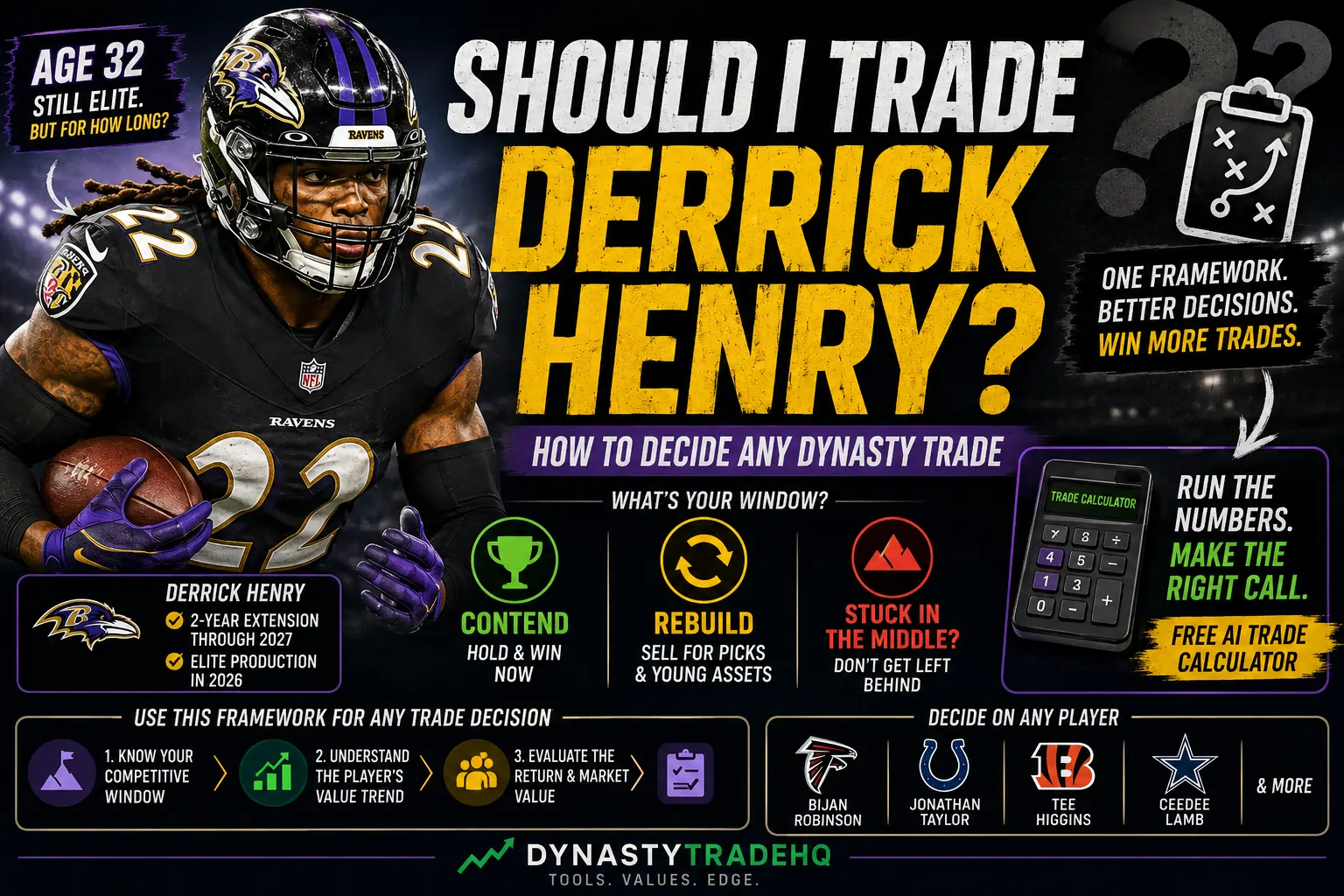
You are staring at a trade offer, and your gut says yes, but your brain says wait. That exact hesitation is what this post untangles. Whether the question on your mind is should I trade Derrick Henry, Bijan Robinson, Jonathan Taylor, or any other dynasty asset, the answer follows the same logic: your roster window, not the player’s talent alone, determines the right call. Run the numbers on your roster in the calculator first, then come back to this framework.
Table of Contents
The Framework Behind Every Smart Dynasty Trade Decision
A dynasty trade decision is not a question about one player. It is a question about where your team is in its competitive cycle and whether the asset you hold fits that window. Talent and the direction of value are two different things. A player can be elite right now and still be the right sell if your rebuild horizon is three years out.
Start by placing your team in one of three buckets: contending now, rebuilding, or stuck in the middle. Contenders trade for players who improve their lineup for the current season. Rebuilders trade proven veterans for draft capital and younger assets. The middle bucket, sometimes called the “danger zone,” is where managers make the most costly mistakes because they hold aging assets while telling themselves the window is still open.
Next, assess the direction of the player’s value. Dynasty value moves in one direction for veterans over 28: down. The pace varies, but the trend does not reverse. The question is not whether a player will decline. The question is whether you want to sell before the market catches on or hold until the market has already priced in the decline.
Finally, check what you are being offered in return. A dynasty trade is only as good as the return, and if the offer does not move your team closer to its goal, whether that goal is a title this year or a rebuild, you do not have to accept. Go to player values to see where your players stand in the current market before you respond to any offer.
The framework sounds simple because it is. The difficulty is applying it honestly to your own roster.
Should I Trade Derrick Henry in 2026?
Derrick Henry, running back for the Baltimore Ravens, is one of the most debated dynasty assets heading into the 2026 season. He signed a two-year, $30 million extension in May 2025 that keeps him under contract through the 2027 season. At 32 years old, he is statistically outlasting every conventional timeline for running backs, but that does not mean dynasty managers should treat him as a long-term hold.
Henry’s situation breaks cleanly along the contender vs. rebuilder line.
If you are contending in 2026: Henry still provides elite production in the Ravens offense. Lamar Jackson remains under contract, the scheme is unchanged, and Henry has shown no signs of a hard physical decline. Holding him and starting him every week is the correct move.
If you are rebuilding or your window is 2028 and beyond: Henry will be 33 to 34 years old in that window. Father Time is undefeated at the running back position, and his dynasty value will not recover once it begins to slide. Sell now while the market still prices in his 2025 production numbers.
What should you expect in return? For a rebuilder dealing with Henry, the floor is a mid-first-round pick plus a secondary piece. Contenders offering less than that are undervaluing what is still a borderline top-10 dynasty running back. Check dynasty rankings to calibrate where Henry sits relative to the full running back tier and what a fair return looks like in your specific format.
The age is real, the value is still there, and the market window to maximize a return is narrowing. Act accordingly.
Should I Trade Bijan Robinson or Jonathan Taylor?
These two running backs represent opposite ends of the dynasty trade calculus, and many managers are sitting on one or both right now.
Bijan Robinson, RB for the Atlanta Falcons, is one of the top dynasty running backs by community consensus in PPR formats. He is young, entrenched as the featured back in Atlanta’s offense, and his value is near its ceiling. Selling Robinson makes sense only if you are getting a haul that genuinely sets up your rebuild. If you are contending, he is not for sale at anything close to fair market.
Jonathan Taylor, RB for the Indianapolis Colts, is the more nuanced case. Taylor is 27 years old, in the final year of his contract, and trade speculation has picked up heading into the 2026 season. Multiple analysts have flagged a potential mid-season NFL trade as a real possibility if the Colts struggle early. From a dynasty standpoint, his situation adds uncertainty to his value. He is still ranked in the RB7 range, but contract questions, high career carry totals, and landing-spot risk complicate projecting his role going forward.
The key distinction between Robinson and Taylor is the length of their respective value windows. Robinson can be the centerpiece of a dynasty team for five or more years. Taylor’s window, while still open, is closing, and holding him in contract limbo without clarity on an extension is a real risk.
If you own both, holding Robinson and trading Taylor for a haul of picks is a defensible move in any league format. Check dynasty rankings at dynasty rankings to compare their current values side by side.
Should I Trade CeeDee Lamb or Tee Higgins?
Wide receivers age better than running backs in dynasty, but that does not mean every wide receiver is an automatic hold. The question of whether to trade a receiver comes down to age, target share certainty, and the strength of the offers available to you.
CeeDee Lamb, WR for the Dallas Cowboys, is 27 years old and sits in the WR6-7 range in dynasty value on most major platforms. That ranking reflects a modest dip from his peak value, tied in part to Cowboys offensive uncertainty. Lamb is still a legitimate WR1. Selling him requires an exceptional return. If someone is offering two top-tier assets or a top-three pick plus a young receiver, that conversation is worth having. If the offer is one asset at roughly equal value, hold.
Tee Higgins, WR for the Cincinnati Bengals, occupies a different tier. He sits in the WR11-12 range on recent dynasty trade value charts, which makes him a borderline WR1 in most formats. His value is heavily tied to Joe Burrow’s health and the Bengals’ offensive efficiency. If you can sell Higgins for a piece that better fits your timeline or a young receiver with a more stable situation, that trade often makes sense.
The general rule for selling a WR: the closer they are to 30, the more seriously you should consider the move if an offer materially above fair value arrives. Lamb is years from that window. Higgins is in it now for some managers, depending on their roster construction and scoring format.
How Scoring Format Changes the Answer
The format your league plays significantly changes whether a trade is worth making. PPR leagues inflate the value of pass-catching backs and slot receivers. Standard leagues reward workhorse runners and outside receivers with target volume on short routes. Superflex leagues shift value toward quarterbacks, compressing the gap between top receivers and elevating the trade cost to acquire an elite back like Henry or Robinson.
A player who is a clear hold in one format can be a reasonable sell in another. Here is how to think about it:
In PPR formats, pass-catching running backs hold more value because their floor is higher on low-volume rushing days. In standard formats, pure rushing backs gain relative value. Tee Higgins, for example, becomes more attractive as a hold in PPR because his route tree generates consistent catch opportunities even in down games.
In Superflex, the opportunity cost of holding a 32-year-old running back is higher because the asset you could acquire instead, a young starting quarterback with rushing upside, compounds in value faster. The should I trade Derrick Henry question becomes an easier yes in Superflex if the return includes a young QB or a first-round pick you can use to draft one.
Before accepting or rejecting any offer, confirm the exact format and scoring settings of your league. A trade that wins in PPR can lose in standard. Use our calculator to adjust your comparison based on your specific league type.
When to Reject a Trade Offer Outright
Not every trade needs a long analysis. Some offers are worth declining immediately, and recognizing them quickly saves time and prevents you from talking yourself into a bad deal.
Reject the offer if the return does not address a genuine roster need. Acquiring a second elite wide receiver when you already have three starters is not an upgrade. The player you are giving up should be replaced with someone who moves your team closer to winning, not sideways.
Reject the offer if the return is entirely made up of future picks. Picks are not players. A haul of three future seconds sounds appealing until you account for hit rates and the time cost of waiting. For a contending team giving up a proven starter, future picks alone rarely make sense.
Reject the offer if the other manager is clearly panic-selling and not offering a fair return. A buy-low target is a player whose value has dropped due to a short-term slump rather than a real skill decline. If someone is trying to sell you their own buy-low target at a premium by masking it as a win-now trade, pass.
The simplest test before accepting any offer: does this trade make you better in the year you expect to compete? If the answer is not clearly yes, the default is to counter or decline. Pulling the trigger on the wrong trade in dynasty does not just cost you this season. It costs you picks and roster flexibility for years.
Is It the Right Time to Make This Dynasty Trade?
Timing matters as much as the trade itself. The right player acquired at the wrong moment in the season can still be a bad deal.
The best windows to trade in dynasty are the offseason and the first half of the regular season. Values are stable, competition for assets is lower, and you have time to integrate a new player before the playoffs. Trading under pressure at the deadline almost always benefits the side that is not panicked.
If you are holding Derrick Henry, Bijan Robinson, Jonathan Taylor, CeeDee Lamb, or Tee Higgins and have received an offer, ask yourself three questions before responding. First: is your window the same as theirs? A seller in rebuild mode and a buyer in contention mode is the ideal trade partner match. Second: Is the value fair right now, today, not six months ago? Dynasty values shift quickly. An offer that looked great in preseason may be below market in October. Third: Are you trading from strength or from fear?
The worst trades in a dynasty are made out of impatience, fear of a slow start, or overreaction to a two-game slump. Decisions made under those conditions almost always favor the other side.
Stop debating in your head and let the data settle it: plug your specific trade into the calculator and see whether the value is actually there.
Run Your Trade Through the Calculator
FAQs
Should I trade Derrick Henry in dynasty right now?
Hold him if you are contending in 2026. He is still elite in Baltimore’s offense. If your window is three-plus years out, sell now before his age-32 value erodes. Rebuilders should expect a mid-first-round pick as the floor.
Should I trade Bijan Robinson in dynasty fantasy football?
Robinson is a top dynasty running back by consensus and should only move for a legitimate package. Hold in nearly every contending situation. Only sell in a full rebuild, and only for multiple first-round picks in return.
Should I trade Jonathan Taylor or hold him in 2026?
Taylor is 27, in the final year of his contract, with real trade speculation building toward the deadline. Rebuilders should sell now for picks given the uncertainty. Contenders can hold through the season but should monitor their situation closely.
Does PPR scoring change whether I should make a fantasy trade?
Yes. PPR formats raise the value of pass-catching backs and slot receivers, shifting both asking price and fair return. A balanced trade in standard scoring can favor one side in PPR. Always confirm your scoring settings before accepting an offer.
