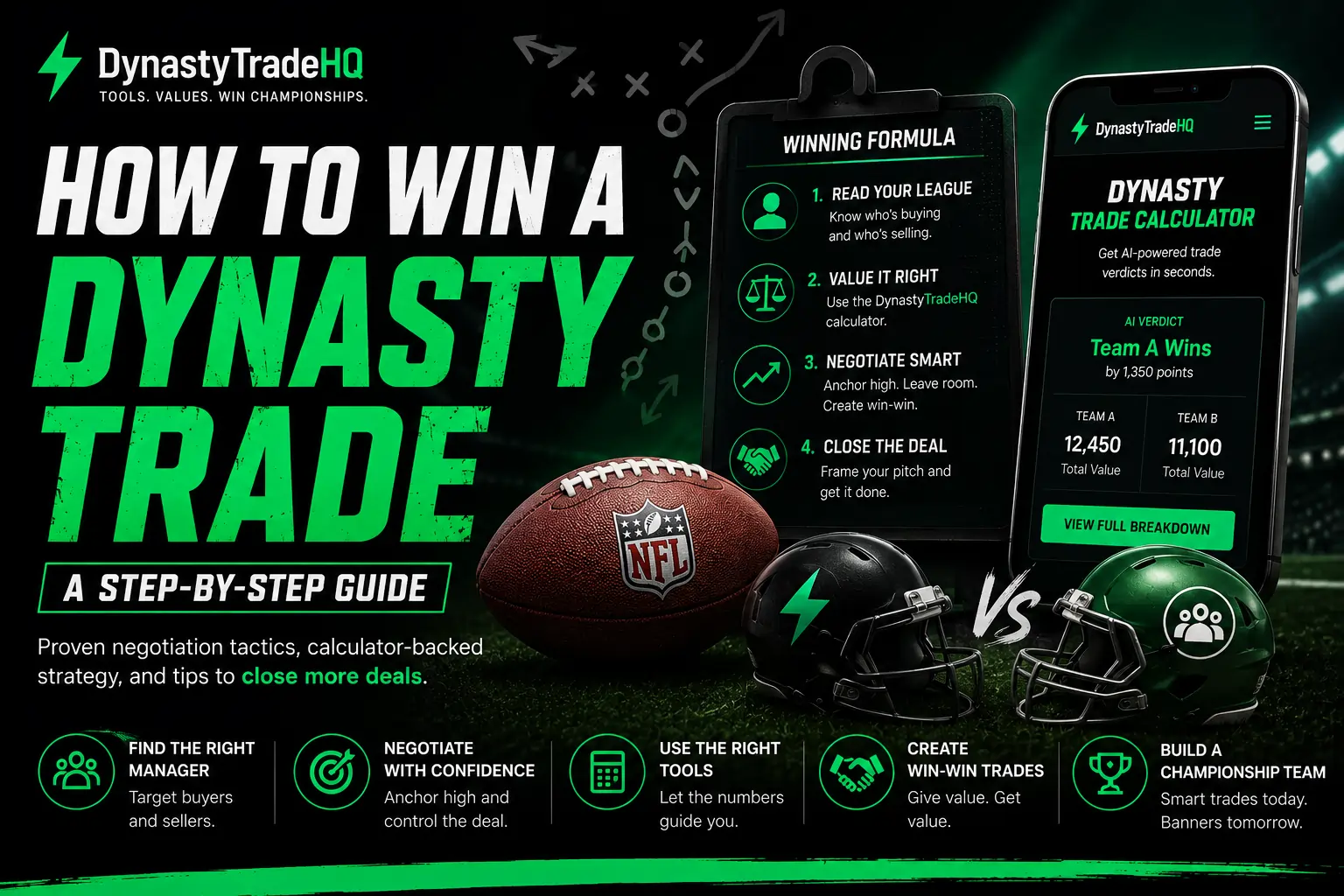
Most dynasty managers lose trades before they ever send the first offer. They target the wrong manager, propose the wrong package, and leave value on the table because they never validated the numbers. This guide breaks down exactly how to win a dynasty trade, from reading your league to closing the deal with confidence. Before you send your next offer, run the numbers at https://dynastytradehq.com.
Table of Contents
Who Are the Buyers and Sellers in Your League Right Now?
The first step to winning a dynasty trade is knowing who in your league is motivated to move. A buyer is a manager whose roster is close to contending and needs one or two pieces to push into title range. A seller is a manager who has missed the playoffs, is aging out of their window, or is sitting on veterans whose value is about to decline. Most managers fall into one of these two buckets at any given moment, and trading with someone whose goals align with yours is the fastest path to a deal that gets accepted.
Before you send anything, scan every roster in your league. Look for the manager who has two elite WRs but no starting-caliber RBs. Look for the team that is 2-7 and holding a soon-to-be 30-year-old running back they paid up for two years ago. Those are your targets. Rebuilding managers want youth and future picks. Contenders want proven production right now, even if it costs them draft capital. Identifying motivation is not manipulation. It is basic negotiation. You are offering something the other manager actually needs, which is the only way a trade gets accepted.
A proposal that ignores the other team’s roster situation sits in the inbox forever. Do this audit before you ever type an offer. The trickier category is the manager stuck in the middle: not good enough to win, not bad enough to commit to a rebuild. These managers are harder to trade with because they have no clear direction. If someone in your league fits this description, you can still trade with them, but you need to frame the deal around where you think their team should be heading. You are not just offering players. You are offering a path.
How to Anchor High in Dynasty Trade Negotiations
Anchoring high is the single most reliable tactic for dynasty trade negotiations. It works in two directions: asking for more than you expect to receive on your side, and offering slightly less than you are ultimately willing to give on theirs. Either way, the goal is the same: to establish the ceiling of the negotiation so the final landing spot is closer to your actual target.
Here is how it works in practice. If you want a WR2 from another team and you are willing to give up your RB3 and a 2027 first, start by offering your RB3 and a 2027 second. You have given yourself room to move. When the other manager counters and asks you to upgrade the pick to a first, you can agree and feel like you made a concession while still landing the exact deal you wanted. Managers who anchor low, or who propose exactly what they think is fair from the start, leave themselves nowhere to go. The other manager counters, and suddenly you are offering more than you ever intended.
One rule with anchoring: the opening offer still has to be in the same neighborhood as reasonable. An absurd lowball is immediately rejected and poisons the negotiation. You want the other manager to see your opening as aggressive but not insulting. A gap they can close with a counter is a productive gap. A gap that makes them feel disrespected ends the conversation. Anchoring also gives you information. If a manager counters quickly and barely moves, their asset is not as available as you thought. If they counter with genuine movement, you have found a deal that can get done.
Targeting Roster-Needy Managers: Finding the Right Trade Partner
A manager with a needy roster is your best trading partner. One who is thin at running back and knows it will pay a premium to fix that hole. The same applies to any position where a team is one injury away from starting a replacement-level player.
The goal is to match what you have in surplus against what they are missing. If you are deep at wide receiver, you have trade chips that carry real value to a WR-needy team. Those same chips might generate no interest from a manager who already has four viable starters at the position. Your surplus at a position they need is the simplest formula for a dynasty trade that gets done.
You can deepen this analysis by looking at the age distribution. A team that is top-heavy with veterans but has no young receivers in the pipeline has a visible weakness that will compound over time. They may not be desperate today, but they know the problem is coming. Framing a trade around solving that future problem, not just a current roster gap, gives you a strong pitch.
How to Frame Your Pitch to a Needy Manager
When you reach out about a trade, do not just send the offer blindly. A short message before or alongside the proposal goes a long way. Something like: “Noticed you are thin at RB and I have some flexibility there, open to talking.” This does two things. It shows you have studied their roster, and it positions the trade as a solution rather than a transaction.
Managers who feel you are trying to help them are far more likely to engage seriously with your offer than those who feel they are being picked off. The tone of your outreach is part of the negotiation.
Check the dynasty rankings to confirm the positional value of what you are offering before you send the pitch.
How to Propose a Trade That Actually Gets Accepted
A trade that is accepted is not always the fairest. It is the trade that feels fair to both sides at the moment of the decision. Understanding that distinction is key to consistently winning negotiations. The structure of your proposal matters as much as the players in it. Sending three players for one player feels unequal, even if the values line up on a calculator. If you want to make that deal happen, try flipping it: ask for two players back instead of one, even if one of the two is a depth piece you do not care about.
The symmetry of the offer, matching quantity on both sides, reduces the psychological friction of saying yes. Keep your proposals clean. Two for two or one-for-one deals close faster than three for two packages in most cases, unless you are dealing with a manager who is analytically minded and will actually do the math. Know your audience. A casual manager responds to name value and roster fit. A spreadsheet manager responds to win probability and value differentials.
Always propose with a reason attached. “Wanted to try this, thought it made sense for both teams” is more compelling than silence. You do not need to justify every decision, but a one-line framing sentence removes ambiguity and keeps the conversation open even if the counter comes back at a different price. Avoid sending multiple offers to the same manager in quick succession. One well-considered proposal signals confidence. Three rapid offers signal desperation, and desperate managers get squeezed in negotiations.
How to Use the Trade Calculator Before You Send Anything
Sending a trade offer without checking the numbers first is the fastest way to lose value you did not know you had. The DynastyTradeHQ trade calculator lets you input both sides of any proposed trade and see the value gap before the other manager ever sees it.
Here is the correct workflow. Build the trade you want to propose. Run it through the calculator. If the deal favors you by a meaningful margin, send it as is; that margin is your negotiating buffer. If the deal is nearly even, it is still worth sending because it is likely to get accepted. If the deal tilts against you, restructure before you send. Drop the extra pick you were throwing in as a sweetener, or ask for a lower-tier player to be added to your side.
The calculator is also useful for evaluating incoming offers. When you receive a trade proposal, run it before you respond. If the value is closer than you expected, that is a sign the other manager has done their homework. If the deal is clearly one-sided against you, you have a baseline for your counteroffer.
Using Player Values to Strengthen Your Position
The player values page at https://dynastytradehq.com/player-values provides a current snapshot of where each asset stands in the market. If a player on your roster has a higher value than the other manager likely realizes, that is information you can use. Propose before their next bad game drops the number. Time your offer around peak value, not convenience.
Is This Trade Actually Worth It? The Bottom Line
The managers who consistently win dynasty trades do three things: they read the room before they propose, they anchor high and leave room to move, and they validate the numbers before the offer leaves their inbox. Use the steps in this guide in order, and you will close more deals, give up less value, and stop second-guessing every trade you make. If you are sitting on a trade offer right now and are not sure which side wins, this is the fastest way to find out. Run Your
FAQs
How do you win a dynasty trade?
You win a dynasty trade by targeting motivated sellers or buyers, anchoring your opening offer above your actual target, and validating both sides’ terms with a trade calculator before sending anything. The manager who has done the most preparation going into a negotiation almost always walks away with the better end of the deal.
How do you negotiate a fantasy football trade?
Start by identifying what the other manager needs, then frame your offer as a solution to their roster problem. Anchor your opening ask high, keep proposals clean and symmetrical, and include a brief message explaining why the deal works for both sides. Counteroffers are normal. Build in room to move so your final landing spot is still a win.
Should I use a trade calculator in dynasty?
Yes. A dynasty trade calculator gives you an objective baseline before you propose or respond to any deal. It tells you whether you are giving up more value than you realize, where your negotiating buffer is, and when an incoming offer is closer to fair than it looks. Use it as a check on your instincts, not a replacement for them.
When is the best time to trade in dynasty fantasy football?
The best time to trade is after a player’s value peaks, either on the back of a strong performance or a positive news cycle. Target assets before their situations improve, and trade away players before a looming decline becomes obvious to the rest of your league. Off-season windows after the NFL Draft and before training camp are typically the most active trading periods.
