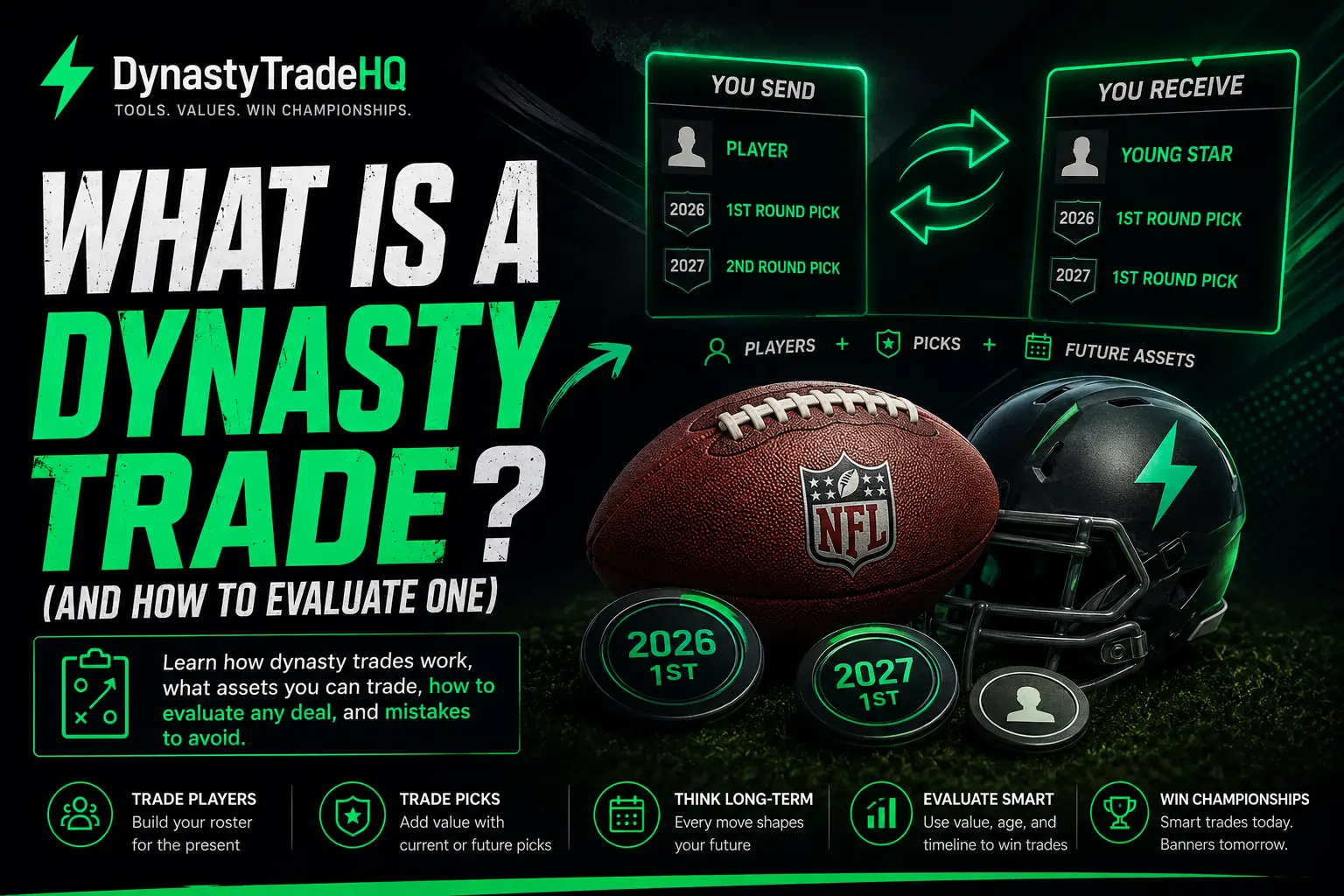
A dynasty trade is an exchange between two managers that can include rostered players, picks in the current rookie draft, and future draft picks, sometimes picks two or three years away from even existing. That last part is what separates dynasty trading from everything else in fantasy football. In redraft, you swap players. In dynasty, you can trade assets that won’t materialize until a rookie class is drafted into the NFL.
Table of Contents
What Makes a Dynasty Trade Different From a Redraft Trade
A dynasty trade operates on a completely different timeline than a redraft trade. Instead of optimizing for the next 17 weeks, you’re making decisions that could shape your roster for the next three to five years, which means both sides of a deal can genuinely win, even on the exact same trade.
In redraft, the logic is simple: you trade players, you want the better player, and value is almost entirely about who’s good right now. Dynasty breaks all three of those rules. You’re not just trading players, you’re trading picks, including future picks that represent roster spots you haven’t even filled yet. You’re not just asking “who helps me this season” but “who helps me during my contention window.” And you’re not competing on equal terms with the other manager, because a rebuilding team and a win-now team can both get exactly what they need from the same deal.
That last point is the real unlock. In redraft, a trade where both sides win feels like a fluke. In a dynasty, it’s the whole point.
| Dynasty Trade | Redraft Trade | |
| Assets involved | Players + picks (future too) | Players only |
| Time horizon | 1–5 years | This season |
| Both sides can win | Yes (different timelines) | Rarely |
| Age matters | Heavily | Minimally |
| Complexity | High | Low |
That complexity is exactly what makes dynasty trading the most strategic layer of the format. Master it, and you’ll have a real edge.
What Can Be Traded in Dynasty Fantasy Football
Dynasty leagues can involve a range of assets in a single trade, not just the players sitting on your roster. Understanding what’s on the table in any given negotiation is the first step to trading well.
Players
Any rostered player in your league is tradeable. A player’s dynasty value isn’t the same as their redraft value, though. A 24-year-old wide receiver with modest current production might be worth significantly more in dynasty than in a weekly-scoring context because of what he represents long-term. Age, athletic profile, and opportunity matter as much as last week’s stat line.
Current-Year Draft Picks
These are picks in the upcoming rookie draft, which happens at the end of the current NFL Draft cycle. Their value is largely tied to projected NFL landing spot, with early first-round picks commanding a premium. Rookie draft positioning can fluctuate significantly through the offseason as trades and free agency reshape NFL rosters.
Future Draft Picks
Future picks are the defining element of dynasty trading and the asset class that makes the format genuinely unique. Managers can trade picks one, two, or even three years out, picks tied to teams that haven’t played a down yet in that season. This is where inexperienced managers most often get hurt. Trading away multiple future firsts without a clear return path to contention is one of the fastest ways to end up in a rebuild you didn’t plan for.
Pick Conditions (Conditionals)
A conditional trade links a specific outcome to how a pick is transferred. For example: “My 2026 first becomes a 2027 first if it lands top-three overall.” Conditionals allow managers to hedge against uncertainty and are common in more serious leagues. Worth noting, not all platforms support conditional trades natively, so check your league settings before structuring one.
Types of Dynasty Trades
Dynasty trades come in recognizable patterns. Learning to identify what type of trade you’re being offered and what the other manager needs puts you in a much stronger negotiating position.
The Sell-High Trade
A sell-high trade means moving a player at or near the peak of their perceived value, before production or age causes that value to drop. The trigger might be a breakout stretch of games, a favorable offseason situation, or simply the fact that a player’s reputation has outpaced their realistic long-term ceiling. A typical structure: you send an aging or recently hot skill-position player and receive a younger player plus a pick, banking on the incoming assets appreciating more than the outgoing one. Timing is everything here; a week or two of waiting can cost you significant return value.
The Buy-Low Trade
The inverse of the sell-high, a buy-low trade targets a player whose dynasty value has dipped below where you believe it should settle. Injury, a slow start, or a temporary role reduction can lower a player’s trade value while their long-term ceiling remains intact. Structure: you send a player the other manager values more than you do, and receive the discounted target. Patience matters; these windows open and close with game results.
The Rebuild Trade
A rebuild trade happens when a contending manager decides to step off the gas and reset toward the future. They move veteran, win-now talent to another team and collect picks and young players in return. The structure is typically: established starters going out, a package of mid-round picks, and developing young players coming back. This type of trade requires an honest self-assessment. Managers who wait too long to commit to a rebuild often move veterans at deflated value, getting less in return than they would have a season earlier.
The Win-Now Trade
The win-now trade is the rebuild trade’s mirror image. A contending manager sends future picks and/or younger players to acquire proven, productive talent that helps them compete immediately. Structure: future firsts and/or youth leave your roster, a reliable veteran arrives. The risk is real; if you don’t win a championship or come close, you’ve weakened your future for nothing. These trades make sense with a genuinely strong roster; they’re dangerous as wishful thinking.
The Pick-for-Player Trade
Sometimes a manager prefers to move a rostered player rather than a draft pick, and another manager values draft capital over an immediate roster addition. In a pick-for-player trade, one side sends one or more draft picks (current or future) and receives a specific player in return. These are common when one manager is rebuilding and prefers the optionality of picks, while the other wants a named asset they can deploy right away.
The Package Trade
A package trade consolidates multiple lower-value assets into one elite asset. The logic: three solid-but-not-special pieces might equal one truly difference-making player in overall dynasty value. Structure: you send two or three players and/or picks and receive a single top-tier player. These trades often require creative negotiation because the other manager has to be convinced that the package is worth simplifying their roster, but for the right elite player, concentrating value is almost always the right move.
How to Evaluate a Dynasty Trade
Evaluating a dynasty trade means comparing the long-term dynasty value of what you’re sending out against what you’re receiving, filtered through your competitive window. A trade that’s correct for a rebuilding team is often wrong for a contender, even if the raw value exchange looks identical.
Step 1: Know Your Competitive Window
Are you contending, rebuilding, or somewhere in between? That single answer should dictate every trade decision you make. A win-now move only makes sense if “win now” is an honest description of your roster. Be ruthless here.
Step 2: Compare Dynasty Values, Not Redraft Rankings
Redraft rankings tell you who’s good this season. Dynasty values tell you who’s worth holding for the next three years. Always evaluate trades using dynasty-specific values Trade Value Chart is built specifically for this.
Step 3: Factor in Age and Position Curve
Every position ages differently, and buying a player at the wrong point on their curve can set your franchise back years. As we covered in our dynasty beginner’s guide, understanding positional aging curves is foundational to evaluating any deal.
Step 4: Use a Dynasty Trade Calculator
Our Dynasty Trade Calculator gives you a data-backed baseline before you negotiate. It supports 1QB, Superflex, PPR, Half PPR, and Standard, so values reflect your actual league type. Use it as a starting point, then apply your own context before hitting send.
Common Dynasty Trade Mistakes to Avoid
- Overpaying for name recognition: A big name carries a reputation premium that rarely matches its actual dynasty value, especially past age 30. Evaluate the production profile and age, not the jersey.
- Trading future firsts without knowing their value: A first from a tanking team and a first from a contender are completely different assets. Know the realistic landing spot before you move any future pick.
- Making win-now trades without a real contention window: Future picks are expensive currency. Spending them only makes sense if your roster can genuinely compete for a title, not just sneak into the playoffs.
- Accepting the first offer without countering is almost never the best option. Counter every time. It’s not rude, it’s how dynasty trading works.
- Treating all first-round picks as equal. “A first” is not a standardized asset. Where it lands determines its value. A potential top-two pick and a late first are not the same negotiation.
When is the Right Time to Make a Dynasty Trade
There isn’t one. That’s the honest answer. But some windows are better than others, and experienced managers position themselves to act at the right moments rather than reacting to whatever hits their inbox.
The early offseason, particularly the stretch right after the NFL Draft, is one of the best buying windows in dynasty. Rookie hype is fresh, newly drafted players are getting maximum attention, and managers who missed the playoffs are often motivated to move assets and reset. If you have a clear target and draft capital to offer, this is the moment to shop.
Training camp creates buy-low opportunities that most managers miss because the news cycle moves fast. A veteran who got injured in a preseason game, a player who lost a starting role in camp, a rookie who entered the year with buzz but slipped in the depth chart- these situations temporarily suppress trade value in ways that don’t always reflect the player’s actual long-term ceiling. Watching camp reports carefully and acting quickly gives you an edge.
Mid-season is trickier. Values shift week to week based on performance, and the emotional volatility of active managers can work in your favor or against you. A manager who just had a star player blow up for four touchdowns will value them higher than they should. A manager who’s 2-6 and frustrated might accept a below-market deal just to shake things up. Stay rational when others aren’t.
The post-season window is underrated. Managers who missed the playoffs entirely are often in a genuine reset mindset by the time the fantasy championship game is over. They’re thinking about next year, they’ve emotionally detached from current assets, and they’re open to conversations they wouldn’t have had in September. Build relationships in your league so these conversations happen naturally.
Frequently Asked Questions About Dynasty Trades
Can you trade future draft picks in dynasty?
Yes, trading future draft picks is one of the core mechanics of dynasty fantasy football. These picks typically span one to three years into the future and are traded as assets representing the roster spots they’ll eventually become. The value of a future pick depends on the source team’s likely record and the projected strength of that year’s rookie class.
How do you know if a dynasty trade is fair?
A dynasty trade is fair when the long-term dynasty value of what you receive is roughly equal to or greater than what you send out, accounting for your competitive window. The most practical approach is to run both sides of the deal through a dynasty-specific value system, like a trade value chart or trade calculator, and then layer in your own situational context. Raw value parity is a starting point, not a final answer.
Can you trade picks you don’t have yet?
Yes, with some limits. Most dynasty platforms allow managers to trade picks two to three years in advance, though the specific range depends on your platform’s settings. The key thing to understand is that when you trade a future pick, you’re committing a real asset, even if it doesn’t exist yet. Losing track of which future picks you’ve already traded is a genuine mistake managers make.
What is a dynasty trade calculator?
A dynasty trade calculator is a tool that assigns dynasty-specific values to players and draft picks and compares both sides of a proposed trade. Unlike redraft tools, dynasty calculators account for age, positional longevity, and long-term upside rather than just current production. Our dynasty trade calculator supports multiple formats, including 1QB, Superflex, PPR, Half PPR, and Standard, giving you a format-accurate comparison before you pull the trigger on any deal.
Should I trade for picks or players in dynasty?
It depends almost entirely on your competitive window. If you’re rebuilding, accumulating picks and young players gives you optionality and roster flexibility. If you’re contending, proven players are worth more to you than picks that may not pay off for two or three years. The mistake most managers make is defaulting to one philosophy regardless of where their roster actually is. Check our dynasty rankings to get a clearer sense of how your current roster stacks up before deciding which direction to trade.
How many players can you include in a dynasty trade?
Most dynasty platforms allow two to four players (or assets) per side, though this varies. Some leagues configure their platforms to allow larger package deals, and a few have no hard limit. Before proposing a complex multi-piece trade, check your platform’s trade rules — there’s nothing more frustrating than building a creative deal that your league software won’t process.
What is a conditional trade in Dynasty?
A conditional trade is a deal where the specific asset exchanged depends on a future outcome. For example, a pick might transfer as a 2026 first-round pick if it falls in the top five overall, but become a 2027 first-round pick if it doesn’t. Conditionals let both sides manage uncertainty, but they require platform support and clear communication to avoid disputes. If your platform doesn’t handle conditionals natively, most leagues work around this through commissioner notes or a separate side agreement.
Now that you understand how dynasty trades work, what they include, how to evaluate them, and when to make them, you’re ready to start trading with real confidence. Run your next deal through our dynasty trade calculator before you accept or send anything. And if you’re still getting comfortable with the format itself, our guide on what is dynasty fantasy football is the right place to start.
