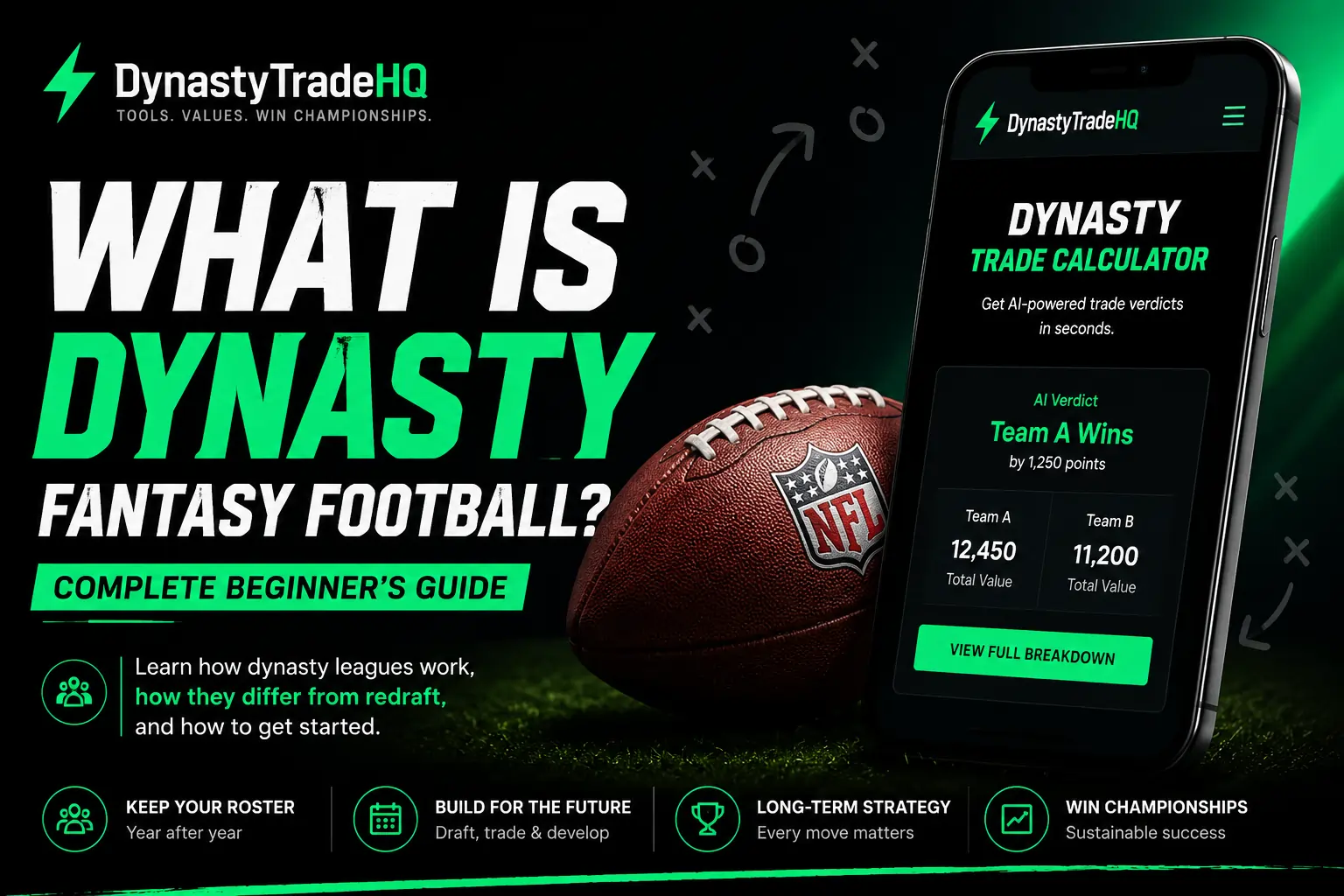
Dynasty fantasy football is a format where you keep your entire roster from year to year, building a team like a real NFL general manager rather than starting fresh each season. Unlike redraft leagues, where everything resets in August, dynasty is a long-term competition where your decisions today shape where your team stands three years from now. That’s what makes it the most addictive, most strategic, and most rewarding format in fantasy sports.
Table of Contents
How Dynasty Fantasy Football Works
Dynasty runs on a simple loop that repeats every year, but the decisions compound over time. You start with a one-time startup draft where every manager fills a full roster from scratch. After that, you keep everything, players, picks, contracts, if your league uses them, and enter each new NFL season with the team you’ve built.
Every spring, incoming NFL rookies become available through an annual rookie draft. Between those anchor events, you’re constantly working the waiver wire, fielding trade offers, managing injuries, and positioning your roster for both the current season and the ones ahead. There’s no offseason in dynasty, not really. The best managers are always thinking, always adjusting, always looking two moves ahead.
The Startup Draft
The startup draft is a one-time event that sets the foundation of your dynasty team. Because you’re drafting an entire keeper roster rather than just a 15-player redraft squad, startup drafts typically run 20 to 30 rounds depending on your league’s roster size. Every eligible NFL player is available, from proven veterans to unproven depth pieces, and your selections here, especially at running back and quarterback, will echo through your franchise for years. Most managers spend more time preparing for their startup than on any other draft they’ll ever do, and using dynasty-specific rankings rather than redraft ADP is essential.
The Rookie Draft
Each spring, after the NFL Draft, dynasty leagues hold a rookie draft to distribute incoming first-year players. Only newly drafted or signed NFL rookies are eligible, and draft order is typically determined by the inverse of the previous season’s standings, so the worst teams pick first, giving them the best chance to rebuild. Rookie picks are tradeable assets, sometimes years in advance, and their value is a core part of dynasty strategy. Landing the right rookie at the right time can flip a rebuilding roster into a contender within a single offseason.
Year-Round Roster Management
Dynasty never really pauses. Between the startup, the rookie draft, and the regular season, here’s what active management looks like:
- Trading players to buy low on undervalued talent or sell high before a player’s value peaks
- Trading future draft picks to acquire proven veterans or future assets, depending on your timeline
- Working the waiver wire to stream depth pieces, pick up late-season breakouts, or fill injury gaps
- Managing your injured reserve (IR) slot to hold long-term injured players without burning a roster spot
- Developing your taxi squad, a developmental roster for rookies who aren’t ready to contribute immediately
Dynasty Fantasy Football vs Redraft: What’s the Difference?
The core difference is permanence. In redraft, your roster disappears after the championship game, and every manager starts equal the following year. In dynasty, every trade, every draft pick, every waiver claim follows you indefinitely.
| Dynasty | Redraft | |
| Roster resets each year | No | Yes |
| Player age matters | Heavily | Minimally |
| Draft picks as assets | Yes | No |
| Time commitment | High | Low |
| Strategic depth | Long-term | Single season |
| Best for | GMs who love roster-building | Casual seasonal players |
In redraft, a 30-year-old running back coming off a 1,100-yard season is still worth a high pick. In a dynasty, that same player might be untradeable because the manager across from you knows the decline is coming. Age and career trajectory aren’t background noise in dynasty; they’re the entire conversation.
Why Player Age and Position Matter More in Dynasty
In dynasty, a player’s age is one of the most important data points you can have. Every position has a production curve, and buying a player at the wrong point on that curve, especially when you give up real assets to do it, can set a franchise back years.
Here’s how the curves break down by position:
- Running backs: peak production typically falls between ages 22 and 26, and they decline faster than any other position; the physical wear of the position is unforgiving
- Wide receivers tend to peak between 24 and 28, with a longer, more sustainable production window than RBs
- Quarterbacks: the most durable position; elite QBs can produce at a high level well into their mid-30s, which is a huge part of why they’re so valuable in Superflex formats
- Tight ends: notoriously slow developers who often don’t hit their stride until 25 to 29, making young TEs both risky and potentially rewarding to hold
This fundamentally changes how you approach trades. A 27-year-old receiver with two strong seasons ahead carries very different value than a 24-year-old with six. In the redraft, both players are roughly equally valuable this week. In dynasty, they’re not in the same conversation.
What is a Dynasty Trade? (And Why It’s Different)
A dynasty trade is an exchange between two managers that can include players, current-year draft picks, and future draft picks, sometimes picks that are two or three years away from even existing. That’s the defining element: dynasty trades aren’t just about the present. A deal might send a 32-year-old running back in exchange for a 2026 first-round rookie pick, and both sides can be right about the trade depending on where each team is in its competitive window. For a full breakdown of how dynasty trades work and how to evaluate them, see our guide on what is a dynasty trade.
Dynasty League Formats Explained
Not all dynasty leagues are built the same. The format your league uses, particularly at quarterback, has a massive effect on player values and how you should build your roster.
1QB Dynasty
In a standard 1QB dynasty league, each team starts one quarterback. Because QB scarcity is reduced, the position carries less premium value, and the emphasis shifts to elite running backs and wide receivers. In 1QB, the gap between a top-10 QB and a top-20 QB is narrow enough that you can win championships without rostering a superstar at the position.
Superflex Dynasty
Superflex changes everything. With a second flex spot that can start a quarterback, every team is incentivized to roster two competent QBs, which creates immediate scarcity. Elite quarterbacks in Superflex formats are worth more than any other position on the board, often by a significant margin. If you’re playing or evaluating a trade in a Superflex league, use our Superflex trade calculator to ensure you’re working with values calibrated specifically for that format.
PPR, Half PPR, and Standard Scoring
Scoring format shifts value for pass-catchers at every position:
- Full PPR (1 point per reception) heavily rewards slot receivers and pass-catching backs who rack up volume even without big yardage totals
- Half PPR (0.5 points per reception) is the most common format and creates a middle ground where volume still matters, but isn’t the only thing
- Standard scoring (no points per reception) compresses wide receiver value and elevates RBs who contribute as true ball-carriers, not just checkdown options.
TE Premium (TEP)
TE Premium leagues award bonus points, typically an additional 0.5 or 1.0 points, for every reception made by a tight end. The effect is dramatic: elite tight ends, such as the top two or three at the position, become among the most valuable players in the entire league. If your dynasty league uses TEP scoring, acquiring and holding a truly elite TE is a foundational part of your roster strategy, not an afterthought.
How to Start Playing Dynasty Fantasy Football
- Find or start a league: Sleeper is the most popular platform for dynasty because of its mobile interface and built-in trade tools, but ESPN, Yahoo, and MyFantasyLeague (MFL) all support dynasty formats with varying levels of customization.
- Understand your league settings before the startup draft: Know your roster size, scoring format, taxi squad rules, and IR slots before you pick a single player. Building for a 1QB league and a Superflex league requires completely different strategies from pick one.
- Prepare for a longer startup draft: A 20- to 30-round startup takes time. Block out the full day, have a tiered ranking sheet organized by dynasty value (not redraft ADP), and don’t panic if you miss a player; there are 30 rounds for a reason.
- Learn dynasty-specific player values, not redraft ADP: Redraft rankings optimize for this season. Our dynasty rankings account for age, contract situation, and long-term upside. A rookie receiver who doesn’t play much this year might be a top-10 dynasty asset. Redraft ADP won’t tell you that.
- Use a dynasty trade calculator before making any trades: Dynasty trades are complicated, and the risk of mismatched values is real, especially as a new manager. Our Dynasty Trade Calculator gives you a data-backed starting point before you agree to anything.
- Think in 3-year windows, not single seasons: The rookie you draft today probably won’t help you win a championship this year. That’s fine. Dynasty rewards patience, and the managers who think long-term tend to win most consistently.
Common Dynasty Fantasy Football Mistakes Beginners Make
- Drafting for this season instead of the next 3 years: It’s tempting to load up on proven veterans in your startup, but dynasty value is built on youth. A 29-year-old running back coming off a great year has real appeal, but a 22-year-old with elite athleticism and a clear path to touches is usually the better long-term hold.
- Overvaluing aging running backs because of name recognition: Name recognition is the most expensive thing you can overpay for in dynasty. A well-known veteran RB trading on two or three good seasons might be weeks away from age-related decline, a committee backfield, or a major injury. The fantasy community tends to value recent production; dynasty managers have to value future production.
- Giving away future first-round picks too cheaply: They are the most universally valuable assets in dynasty leagues. A first-round rookie pick one or two years out could be a top-5 pick if the team currently sitting on it collapses, and that possibility has real value. New managers often trade away future picks to win now without fully understanding what they’re giving up.
- Treating dynasty trades like redraft trades: In redraft, a fair trade is often a straight-up player swap at equivalent current value. In dynasty, you might trade a player for a pick that doesn’t come due for 18 months, or package two depth pieces for one elite asset. The timelines and the math are different, and applying redraft logic to dynasty trades is one of the fastest ways to fall behind.
- Quitting after one bad season: Dynasty has a longer feedback loop than any other format. A team can look terrible for a full year while quietly accumulating draft capital and young players, then emerge as a legitimate contender the following season. Managers who abandon their franchise after a rough year almost always do so right before the rebuild pays off.
Is Dynasty Fantasy Football Worth It?
Yes. And I say that knowing it’s not for everyone.
Dynasty asks more of you than any other fantasy format. You can’t coast in the offseason. You have to care about the NFL Draft in April, rookie minicamp reports in May, training camp battles in August, and bye weeks in November. There’s no resetting and starting clean. Every mistake lives on your roster.
But that’s also exactly why it’s so rewarding. When a rookie you drafted in the third round of your startup draft becomes an elite WR2 three years later, you feel it differently than when you pick him up off waivers for a two-week rental. The ownership is real. The long-term planning, the patience, the willingness to eat a hard season in exchange for a better position two years from now: that’s what separates dynasty from every other format.
If you like football as a sport, not just a gambling product, dynasty is the closest fantasy format gets to actually running a franchise. You develop players, you manage a roster over time, and you live with the consequences of your decisions. That’s the whole thing. It’s harder than redraft. It’s also better.
Frequently Asked Questions About Dynasty Fantasy Football
How many players are on a dynasty roster?
Dynasty rosters typically hold between 25 and 35 players, though league settings vary. Unlike redraft leagues, where a 15-player roster is standard, dynasty teams need depth to account for long-term injury management, taxi squad development, and the stashing of players who aren’t contributing yet but have future upside. Some leagues run even larger rosters of 40 or more players when taxi squads are factored in.
How long does a dynasty league last?
A dynasty league is designed to last indefinitely, with no preset end date. In practice, most active dynasty leagues run for many years, with the same core group of managers competing season after season. The long-running nature of the format is intentional: it creates genuine rivalries, long-term trade relationships, and a history that makes each season more meaningful.
What’s the best platform for dynasty fantasy football?
Sleeper is widely considered the best platform for dynasty leagues, particularly for its mobile app, free-agent bidding tools, and commissioner customization options. MFL (MyFantasyLeague) has historically been the preference for competitive or high-stakes leagues due to its deep customization. ESPN and Yahoo support dynasty formats but offer fewer dynasty-specific tools and are generally better suited for casual leagues.
How is dynasty different from keeper leagues?
In keeper leagues, managers retain a limited number of players, usually one to three, while the rest of the roster is released and redrafted annually. Dynasty keeps your entire roster every year with no release requirement. That fundamental difference significantly changes the scale and complexity: dynasty leagues involve full-roster management, a rookie draft system, tradable future picks, and taxi squads, none of which typically exist in keeper formats.
How do dynasty trade values work?
Dynasty trade values assign a point-based number to every player and draft pick that reflects their long-term dynasty value rather than just their current-season value. A player’s value accounts for age, current production, positional scarcity, and future upside, which is why a young receiver with modest current stats might carry higher dynasty value than an older receiver coming off a great year. Our trade value chart tracks updated dynasty values so you always have a current reference point before accepting or offering a deal.
What happens to players who retire in dynasty?
When a player retires, most leagues move them to a retired designation, freeing up the roster spot, but policies vary. Some leagues allow managers to stash retired players on IR in case they return (which NFL players occasionally do), while others require immediate release. A few leagues with deep customization even allow managers to place a retirement hold on a player for one season. Check your specific league rules; this is one of those situations where getting clarification from the commissioner before it happens is much better than figuring it out after.
Is Dynasty Fantasy Football free to play?
Many dynasty leagues are free to play, depending on the platform and whether your league runs with a buy-in. Sleeper, ESPN, and Yahoo all offer free dynasty league hosting. Some leagues operate as paid leagues with entry fees and prize pools, but that’s a commissioner’s decision, not a platform requirement. The tools on DynastyTradeHQ, including our player rankings, trade value chart, and player comparison features, are completely free to use regardless of your league setup.
Once you understand how dynasty works, the next step is learning how to evaluate trades without getting burned. Use our dynasty trade calculator to review any deal before you accept or decline it. It takes about 60 seconds and covers 1QB, Superflex, and every scoring format.
