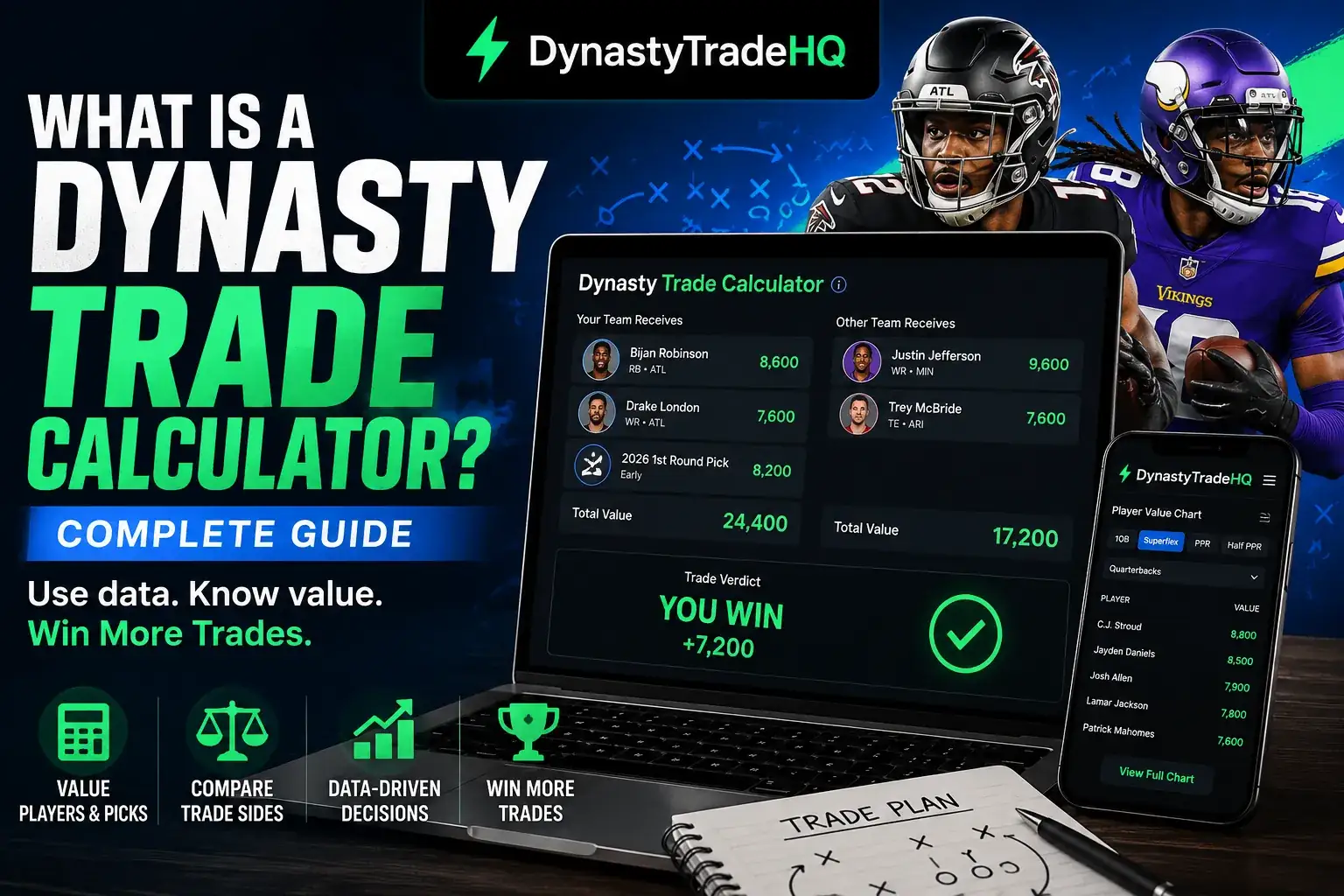
If you have ever stared at a trade offer in your dynasty league and had no idea whether to accept, reject, or counter, you are not alone. A dynasty trade calculator is the tool that removes the guesswork by assigning a numerical value to every player and draft pick, so you can see instantly which side of a deal is winning. This guide explains exactly how the tool works, what its limits are, and how to use it to get more out of every negotiation. Before your next trade, run the numbers at https://www.dynastytradehq.com.
Table of Contents
How a Dynasty Trade Calculator Actually Works
A dynasty trade calculator assigns a numerical score to every player and draft pick in the game. You add the assets being traded on each side, the tool totals the value on both sides, and the gap between those totals tells you who is winning the deal and by how much.
The score for any given player is not a random number. It is derived from a combination of inputs: current NFL performance, age relative to position, contract or depth chart situation, positional scarcity, and long-term production projection. Draft picks are scored on a tiered basis, with first-round picks carrying the highest value and later rounds declining from there, though the specific year of the pick and the team it belongs to can shift that number considerably.
Most calculators do one of two things to set those values. Some use crowdsourced data, aggregating actual completed trades from large platforms to find where the market has settled. Others use expert-set rankings, where analysts assign values based on film, metrics, and their own dynasty projections. DynastyTradeHQ uses its own value system, which you can review at the dedicated trade values page.
The key thing to understand is that the calculator output is a market reference, not a verdict. It tells you what the trade is worth in the abstract. It does not know your roster, your league’s waiver wire depth, or that your league-mate desperately needs a running back before the playoffs. Those factors belong to you. The tool handles the math; you handle the context.
Dynasty vs. Redraft: Why You Need a Different Calculator
Using a standard redraft trade calculator on a dynasty deal will produce the wrong answer almost every time. The two tool types are built on fundamentally different assumptions about what player value means. A redraft trade calculator cares only about this season. A 30-year-old receiver with two years of production left and a 22-year-old receiver coming off a quiet rookie year might look roughly equal in a redraft calculator. In a dynasty calculator, the 22-year-old is worth significantly more because his best years are ahead of him and the older receiver’s value will drop sharply by next offseason.
Dynasty calculators also price draft picks very differently. In redraft formats, a pick in next year’s draft is a minor asset because the player acquired will have exactly one season to contribute before the league resets. In dynasty formats, a first-round pick is a long-term asset, potentially holding its value for years while the selected player develops. The dynasty calculator accounts for this by assigning real, sometimes substantial, value to future picks, especially early-round picks in leagues with strong rookie classes.
Positional value also shifts. Quarterbacks in superflex or 2QB dynasty leagues are priced like premium assets because the position is artificially scarce. A redraft calculator built on standard one-QB settings will severely underprice a dynasty quarterback. If you are in a superflex format and you are not using a calculator that specifically adjusts for it, you are trading blind. The simplest frame: a redraft calculator measures what a player does this year. A dynasty calculator measures what a player is worth to your roster for the next three to five years.
League Settings That Change Everything
Plugging your trade into a dynasty calculator with the wrong settings is almost as bad as not using a tool at all. Certain inputs swing player values dramatically enough to flip which side of a trade is actually winning. The most impactful setting is the quarterback format. In a one-quarterback league, quarterback values are elevated but not extreme. Switch to superflex, where a second QB can be started in the flex spot, and top quarterbacks can more than double in relative value compared to other positions. A trade that looks fair in one-QB can be badly lopsided in superflex. Always confirm this setting matches your actual league before reading any output.
Scoring format is the second major input. PPR (point per reception) inflates the value of high-volume pass catchers, particularly wide receivers and pass-catching running backs. Standard scoring compresses those values and makes ground-heavy backs more competitive in relative terms. Half-PPR falls in the middle. The difference between PPR and standard can shift the winner of a trade involving two players at the same position.
League size matters too. In a 10-team league, there is more depth available off the waiver wire, which slightly suppresses the value of borderline starters. A 14-team league has thinner rosters across the board, so even the 30th wide receiver has some real scarcity value. A calculator calibrated to 12 teams will not perfectly reflect your 14-team reality. Tight end premium, where tight ends receive 1.5 points per reception instead of 1.0, meaningfully boosts the value of elite tight ends. If your league uses it, make sure the calculator does too, or the top tight ends will look cheaper than they actually are.
How to Read the Output Without Overreacting to the Numbers
The number the calculator returns is a percentage difference, a point gap, or a letter grade depending on which tool you use. None of these outputs mean you have found the objectively correct answer. They mean you have a calibrated starting point for your evaluation.A trade where one side is 5 to 10 percent ahead in raw value is generally considered close to even. Most experienced dynasty managers accept that slight imbalance in either direction as the cost of finding a willing trade partner. A gap above 15 or 20 percent starts to indicate real unevenness, and anything beyond that warrants a serious look at what you might be giving away.
Where newer players go wrong is treating the calculator’s verdict as a ceiling on what they should accept. Real trades involve negotiation incentive, which means the side giving up more value is often doing so deliberately to get a deal done. A player selling high on a receiver who just had a career season may have to give a small amount of surplus value to convince the other manager to sell. That is not a bad trade. That is how dynasty markets work.
The calculator also cannot account for situational factors. A contender trading away a first-round pick to win now is making a roster decision, not a value decision. A rebuilder acquiring that pick below market value because the contender needed the win-now piece is doing exactly what they should. The tool tells you the value gap. Your league context tells you whether that gap is acceptable given where your roster is headed. For a deeper look at how values are constructed and updated, see the dynasty trade value chart.
Draft Picks Inside the Calculator: What the Grades Mean
Draft picks are among the most misunderstood assets in dynasty, and the calculator is where a lot of that confusion starts. A pick listed as a “2026 first” does not have a single fixed value. The score it receives from the calculator is an estimate of the median value of that pick, meaning what the pick is most likely to yield if you played the same scenario many times across many leagues.
First-round picks in a strong rookie class year carry higher values than first-round picks in a weak class because the expected return on drafting in the top 12 is higher. Second-round picks drop off considerably in most calculators because the historical hit rate on late-round dynasty rookies is much lower. Third-round picks and beyond are generally treated as depth lottery tickets.
The year the pick is tied to also changes its value. A first-round pick owed in the current year is worth more than a first owed two years from now because there is no uncertainty about where the pick lands. A future first-round pick from a rebuilding team is worth more than the same pick from a contending team because a rebuilding team is more likely to draft near the top.
Some calculators allow you to designate picks as top-5 protected, top-3 protected, or unprotected, which changes the value score. If your calculator does not have this feature, apply your own discount mentally for picks with heavy protection attached. One consistent rule: do not treat a second-round pick as equivalent to a first-round pick just because the value gap looks small in the calculator. The distribution of dynasty-relevant talent historically concentrates at the top of the first round. The numbers reflect that, and you should too. For more on how picks are valued relative to players, see dynasty rankings.
Is the DynastyTradeHQ Calculator Different From an AI Trade Analyzer?
This is a question worth addressing directly because the terms get used interchangeably in fantasy content, and they describe different things. A dynasty trade calculator is a values-based tool. It has a database of player scores; you input two sides of a trade, and it returns a mathematical comparison. The intelligence in the tool comes from how well those underlying values are built and maintained. The output is a number.
A dynasty trade analyzer that uses AI goes further. It can interpret context, flag patterns, suggest alternatives, and generate a written breakdown of why a trade does or does not make sense for your specific roster situation. It processes language, not just numbers. For a full breakdown of what AI-powered analysis adds to the evaluation process, see the dynasty trade analyzer guide.
The calculator is the right tool when you need a fast, objective value check before a negotiation. The AI analyzer is the right tool when you want a reasoned breakdown of the full trade, including factors the numbers alone do not capture.
DynastyTradeHQ’s calculator is free to use with no login required. It adjusts for league format, scoring, and team size. The player values are updated to reflect current market conditions, so the number you see today reflects where the dynasty market actually is, not where it was six months ago. Use the calculator first to confirm the trade is in the right ballpark. Use the AI analyzer when you want to stress-test a specific deal before you pull the trigger.
Is a Dynasty Trade Calculator Worth Using Before Every Trade?
Yes, running a dynasty trade calculator before every significant trade is worth the two minutes it takes. Even if you already have an instinct about the deal, the tool will either confirm your read or surface a gap you had not spotted. Both outcomes are useful. Stop guessing on dynasty trades and get an objective value check before you respond to your next offer.
Run Your Trade Through the Calculator
FAQs
What is a dynasty trade calculator?
A dynasty trade calculator is a tool that assigns numerical values to players and draft picks in dynasty fantasy football, then compares the total value on each side of a proposed trade so you can see instantly whether the deal is fair, one-sided, or worth countering.
How accurate is a dynasty trade calculator?
A dynasty trade calculator is accurate enough to catch meaningfully lopsided trades and confirm close deals, but it is not a perfect predictor. The values reflect market consensus, not certainty. Treat the output as a strong reference point, not a final ruling, and factor in your roster needs and league context before deciding.
Do dynasty trade calculators work for superflex leagues?
Yes, most dynasty trade calculators include a superflex toggle that adjusts quarterback values upward to reflect the format’s increased positional scarcity. Always confirm the setting matches your league before reading the output, because using the wrong QB format can significantly distort the results.
Can I use a dynasty trade calculator for draft picks as well as players?
Yes. Dynasty trade calculators include values for draft picks across all rounds and years. First-round picks hold the highest value, with later rounds declining sharply. Some calculators allow you to factor in pick protections, which changes the score to reflect the realistic range of where the pick might land.
