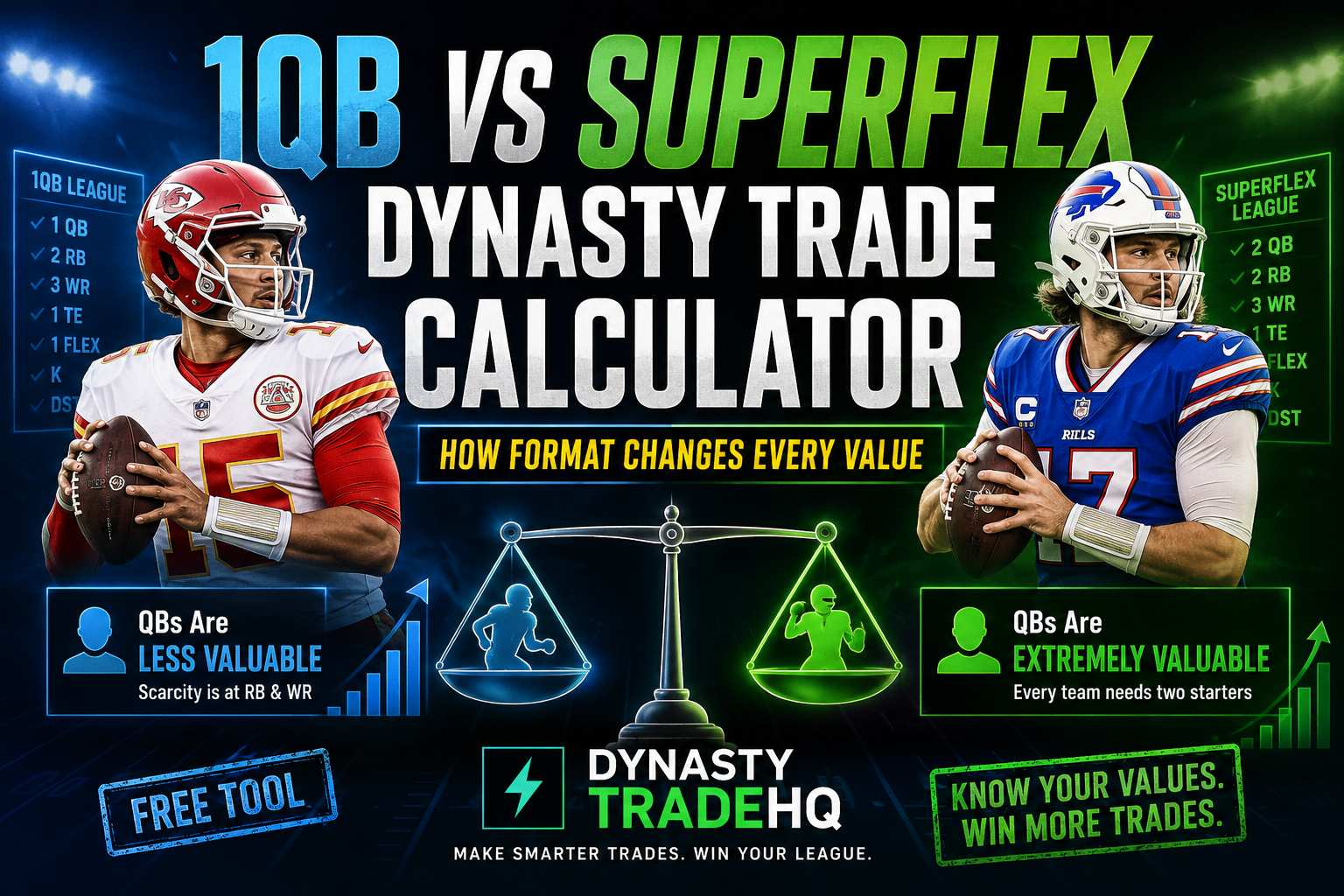
Running the wrong trade calculator for your format is one of the most common mistakes in dynasty. A quarterback who sits in the middle of a 1QB value chart can be the single most valuable asset on your entire roster in superflex. Before you send or accept any trade offer, you need a superflex dynasty trade calculator that reflects your actual league rules, not a generic chart built for a different format. This post breaks down exactly how 1QB and superflex formats produce different valuations and where managers consistently get it wrong. You can check current values for your format right now at https://dynastytradehq.com.
Table of Contents
Why Format Is the Starting Point, Not an Afterthought
The format of your dynasty league is the single biggest variable in trade valuation. A trade that looks even in a 1QB league can be a disaster in superflex, and vice versa. In a standard 1QB league, you start one quarterback every week. Because the position is universal across all rosters, the scarcity that drives value sits at running back and wide receiver. Quarterbacks outside the top five or six have marginal trade value because most teams are already adequately covered. Trading for a QB2 in 1QB is rarely worth a meaningful return.
Superflex changes the math entirely. Superflex leagues allow a second starting spot that can be filled by any position, and in practice the overwhelming majority of managers fill that spot with a quarterback. That means every team now needs two viable starting quarterbacks instead of one. Supply stays the same but demand doubles. That scarcity is what makes elite quarterbacks worth first-round picks and sometimes more.
The consequence for trading is significant. If you use a 1QB calculator to evaluate a deal in a superflex league, you will consistently undervalue the quarterback on your side of the trade. You will give him up too cheaply or accept too little in return. If you use a superflex calculator in a 1QB league, you will overpay for quarterbacks your league simply does not reward at that level. The first question before any trade evaluation is not who is better. It is which format are you playing in, and are you using a tool calibrated to that format.
How Quarterback Values Shift Between Formats
The gap between 1QB and superflex quarterback values is not a small adjustment. It is a structural difference in how the position is priced. In a 1QB league, starting quarterbacks above the top five carry modest trade value. The positional depth in the NFL means that serviceable fantasy quarterbacks are widely available on waivers or at low cost via trade. Paying significant dynasty capital for a QB6 makes little sense when a free agent can cover the gap.
In superflex, the threshold for what counts as a startable quarterback tightens. You now need two weekly starters, and the drop-off in reliability below the top twelve or so quarterbacks is steep. Managers who are short a quality QB2 feel that gap every week. The result is that young quarterbacks with long-term starter potential carry dramatically more value in superflex. A 24-year-old starting quarterback on a good offense might be a borderline trade chip in 1QB. In superflex, that same player can headline a trade return because managers are willing to pay a premium for years of positional security at a scarce spot.
This is also why quarterback-heavy rosters have a real structural advantage in superflex leagues. The surplus is tradeable. Teams that drafted or traded for three viable starting quarterbacks can convert that depth into skill position assets that other teams need, at favorable rates. When you run numbers through the superflex dynasty trade calculator, the point spread between QB tiers reflects this scarcity directly.
Where Running Back and Wide Receiver Values Land
A natural follow-up question is whether non-quarterback values change between formats. The short answer is yes, but less dramatically than you might expect. Wide receivers hold roughly comparable value in both formats. Dynasty WR value is driven by age, target share, and the quality of their offense, and none of those factors change based on how many quarterbacks your league starts. The top wide receivers in dynasty are elite in both formats.
The mid-tier receivers, roughly the WR15 through WR30 range, carry slightly more value in 1QB leagues because they compete for the top of the trade market with quarterbacks who are valued lower in that format. Running back value also stays relatively stable across formats. The position carries its own built-in scarcity driven by workload, injury risk, and short career windows. A proven every-down back in his mid-20s is a top trade piece in both 1QB and superflex.
Where things get interesting is in the middle tiers of each position group. In superflex, a reliable veteran quarterback can be worth more than a WR3 or a committee back who might be available at similar cost in 1QB. Managers sometimes discover that swapping a position-of-need deal for a quarterback package makes more sense in superflex than they initially expect. Check positional values across both formats at player values before you finalize any offer.
Draft Pick Values Are Format-Dependent Too
Rookie picks do not carry identical values across formats, and this is a detail that managers frequently miss when negotiating multi-asset trades. In 1QB leagues, rookie picks derive their value primarily from the skill positions. First-round picks in strong draft classes are valuable because they represent potential WR1 or RB1 talent at a low cost. The value of any given pick is tied closely to the position of the players likely to come off the board in that range.
In superflex, rookie quarterbacks push first-round pick values higher. When a draft class includes a projected starter at quarterback, the picks likely to land that player become more contested because they address a scarce roster need. The 1.01 in a superflex league where a highly-touted QB is the consensus top prospect will trade at a steeper premium than the same pick in a 1QB league.
Later picks, second and third round, follow a similar but inverted pattern. Because non-quarterback prospects dominate those rounds, the format difference matters less. A 2.05 is roughly comparable in value between a 1QB and superflex league because it is unlikely to land a startable quarterback. When you are packaging picks into a trade, confirm the picks are being valued against the right format chart. A first-round pick negotiated using a 1QB chart in a superflex league may be leaving meaningful value on the table.
Common Trade Mistakes Managers Make by Format
Several trade patterns come up repeatedly when managers misapply their format context, and recognizing them is worth your time. Selling a QB too cheap in superflex is the most costly error. A manager who is comfortable carrying three quarterbacks may underestimate what their third-best QB is worth to a superflex team that is genuinely short at the position. That asset has real market value. Do not give it away as a throw-in.
Overpaying for a QB in 1QB is the mirror mistake. Managers who previously played in superflex sometimes carry the inflated QB values from that format into a league where they do not apply. A veteran quarterback with two or three good seasons left is not worth a first-round pick in 1QB. Do not let a trade partner convince you otherwise.
Ignoring rookie quarterback value in superflex drafts is a third pattern. A rookie QB who projects as a long-term starter has positional value that should factor into trade negotiations during and after the startup. In 1QB, that same player may not move the needle much until he proves himself. For more on how AI-assisted analysis can flag these mismatches before you send an offer, see dynasty trade analyzer ai guide.
Is Your Trade Calculator Set to the Right Format?
The most important check before running any trade evaluation is confirming that your calculator is using the correct format settings. A superflex dynasty trade calculator applies values built around the assumption that QBs compete for two starting spots. A 1QB calculator does not. Plugging the same trade into both tools will produce noticeably different verdicts, and the one that reflects your league rules is the correct one.
DynastyTradeHQ gives you separate value sets for 1QB and superflex so the comparison maps to what your trade is actually worth in your league, not a theoretical average. If the format of your league has ever made you second-guess a trade value, run the same deal through both settings and see the gap for yourself.
Run Your Trade Through the Calculator
FAQs
What is a superflex dynasty trade calculator?
A superflex dynasty trade calculator is a tool that assigns trade values to players and picks using pricing built for leagues where a second quarterback can be started. It weights quarterback value significantly higher than a standard 1QB calculator because the position is scarcer when two starters are required each week.
How much more valuable are quarterbacks in superflex vs 1QB dynasty?
Elite quarterbacks are typically worth two to three times more in superflex than in 1QB dynasty leagues. A starting-caliber QB2 who has near-zero trade value in 1QB can be a legitimate first-round asset in superflex because demand for the position is doubled with no increase in supply.
Does it matter which dynasty trade calculator I use if I play 1QB?
Yes. Using a superflex calculator in a 1QB league will cause you to overpay for quarterbacks and undervalue skill position players relative to what your actual market supports. Always confirm that the calculator you are using matches your league format before running any trade evaluation.
Should I use a different trade calculator for trades involving rookie picks?
You should use the same format-matched calculator for picks as you do for players. Rookie pick values shift in superflex when a draft class includes a top quarterback prospect because those picks attract a premium from QB-needy teams. A 1QB calculator will not reflect that premium.
