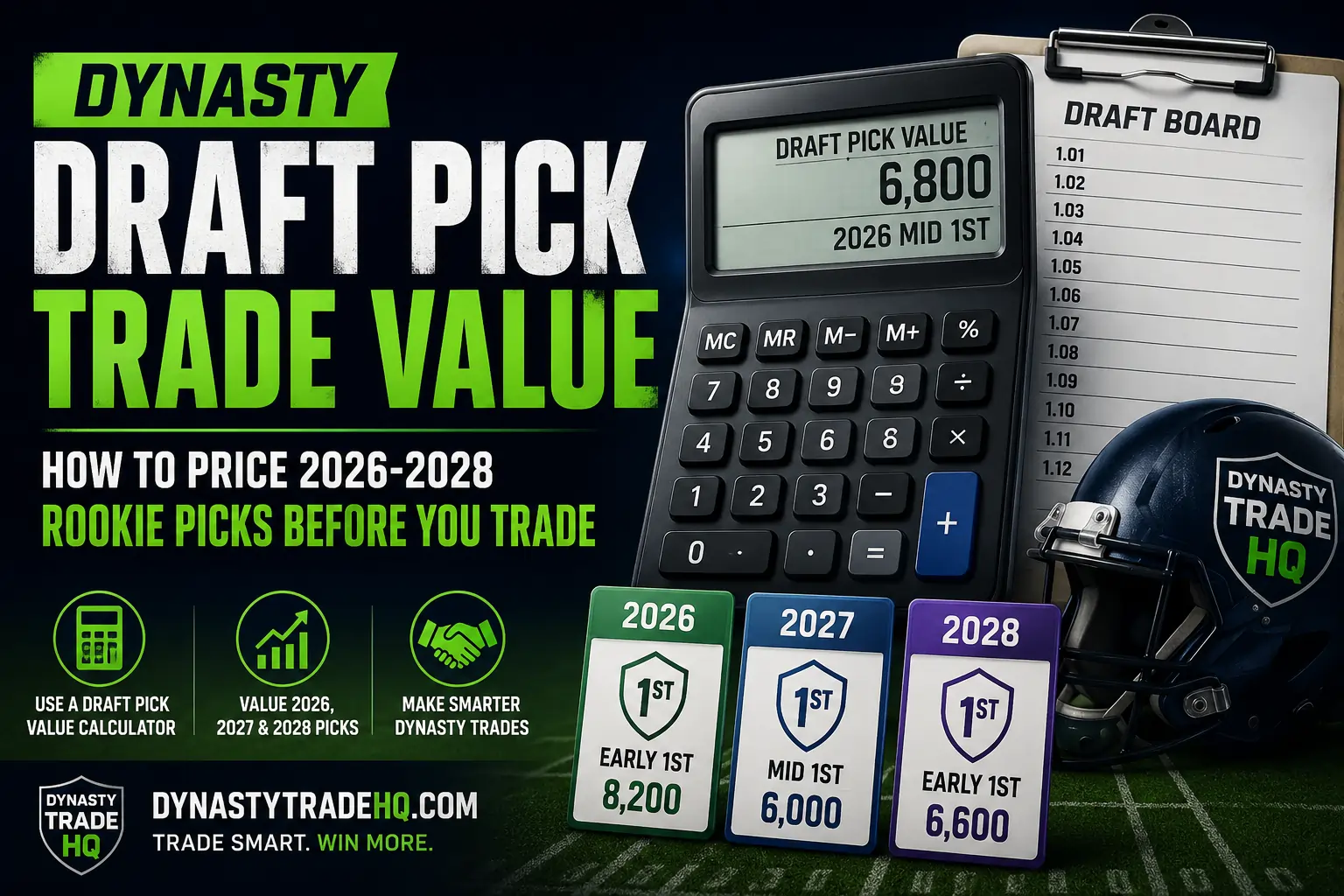
You are sitting on a future first-round pick, and someone just offered you a veteran starter. Before you accept or counter, you need to know what that pick is actually worth today, not what your gut says. A draft pick value calculator takes the guesswork out of this by assigning a number to picks based on expected round, league format, and year. This guide breaks down how to value 2026, 2027, and 2028 rookie picks, so you can walk into any trade negotiation with a clear number in mind. Before running any pick trade through the calculator, it helps to understand the framework behind the numbers. Here is what you need to know.
Table of Contents
How a Draft Pick Value Calculator Works
A draft pick value calculator is a tool that converts the uncertainty of a future draft pick into a tradeable number, using round position, year, and league format as inputs. Most calculators assign a range of values to each slot because a first-round pick can land anywhere from the 1.01 to the 1.12, and those two outcomes are not remotely equal in dynasty.
The core logic behind any good calculator follows the same structure. A 2026 first-round pick is the most concrete asset because the slot is now known after the NFL Draft settled. A 2027 first is more speculative, and a 2028 first is essentially a futures bet. The further out the pick, the wider the value range, and the bigger the discount you should demand as the seller.
Format matters a great deal here. In Superflex leagues, quarterback-heavy rookie classes compress value across the first round, pushing even late firsts higher than they would be in a 1QB format. In 1QB leagues, the position scarcity at wideout and the running back replacement cycle tend to make top-three picks dramatically more valuable than picks 4 through 12.
Slot position within a round is the other major variable. The difference between a 1.01 and a 1.04 in the 2026 class is meaningful. The 1.01 likely landed on a rookie who is already projected as an immediate starter. The 1.04-1.08 range has greater variance. Anything from 1.09 on starts blending into second-round territory for practical purposes in most dynasty formats.
When you use the DynastyTradeHQ draft pick value calculator, it accounts for these variables, giving you a fair starting point rather than relying on instinct.
2026 First-Round Pick Value: What You Are Actually Trading
The 2026 rookie class has already been drafted by NFL teams, which means the guesswork on slot value is largely resolved. What is left is projecting how those players perform over their dynasty careers, which is the part where managers diverge most, and draft slot alone does not always tell the full story.
Take Jadarian Price, who actually went 32nd overall, the last pick of the first round, yet landed in one of the best possible spots for immediate touches after Seattle lost Kenneth Walker III in free agency and Zach Charbonnet opened the season recovering from a torn ACL. A late first-rounder who lands a starting role is often worth more in dynasty than a much earlier pick who lands buried on a depth chart. That is exactly the trap at quarterback: Ty Simpson went 13th overall to the Rams, a premium draft slot, but he is sitting behind Matthew Stafford, who has no plans to step aside soon. Simpson is a legitimate long-term stash in Superflex, not a player who should be priced like he has an immediate path to snaps.
The lesson for pricing 2026 picks: draft slot tells you how a team valued a prospect on draft weekend, but it does not tell you about opportunity. Cross-reference landing spot and depth chart before you assume a pick’s slot alone sets its dynasty value.
The 1.05-through-1.08 range is where most trade conversations happen. Picks in this range have real upside but meaningful variance, either because the player landed in a crowded depth chart or because their position carries inherent boom-bust risk. A late first, like 1.10 through 1.12, is worth roughly a proven WR2 or an ascending RB with one strong season under his belt, and Price’s landing spot is a good example of why a pick that late can still outperform its slot.
One common mistake: dynasty managers overvalue the 2026 first-round pick they own because they watched the NFL Draft and got attached to a story. The pick is worth what the market says it is worth, not what the draft hype told you. Check the dynasty rankings to calibrate before negotiating.
If you are on the sell side of a 2026 first, the best time to move it was before the NFL Draft, when the class was unknown, and anticipation was running high. The second-best time is right now, while optimism about the 2026 season is still intact and before injuries erode rookie values in August.
How to Value 2027 Dynasty Rookie Picks
The 2027 class is generating unusually high buzz this far out, and that hype is already baked into the asking price for 2027 first-round picks in most league markets. Arch Manning, Dante Moore, and a handful of other highly-rated prospects are driving chatter, which means the market for 2027 firsts is running warmer than it typically would at this stage.
Dynasty draft pick value follows a predictable calendar cycle. Future picks are at their cheapest in early fall when competing managers are focused on their current rosters and weekly matchups. They peak in late winter and early spring as the hype cycle for the incoming class builds. If you want to buy 2027 picks, you are buying at a premium right now.
The practical framework for valuing a 2027 first is straightforward. Start with the assumption that a top-three 2027 first-round pick is worth roughly what a 2026 top-three pick was worth before we knew who would be at the top of that class. Add a discount of roughly 15-25 percent to account for the additional year of uncertainty. A 2027 1.01 through 1.03 is a legitimate dynasty asset. A 2027 first in the 1.07-through-1.12 range is a secondary piece, not a headline piece in a trade.
One practical rule on 2027 picks: if you are a contending team, sell them into the hype. Manning and Moore are real prospects, but plenty of hyped future classes have delivered second-round outcomes at the top of the board. Lock in proven value while the market is paying a premium for speculation.
2028 Rookie Picks: Futures Trading in Dynasty
A 2028 dynasty draft pick is the most speculative asset you can trade. No one knows who will be in that class, which team will have the first pick, or what the league landscape looks like two full seasons from now. Trading a 2028 pick is closer to buying a lottery ticket than making a calculated dynasty move.
That does not mean 2028 picks have no place in trades. A rebuilding team that is rationally stockpiling picks should always be willing to collect a 2028 first-round pick as part of a larger deal. The mistake is treating a 2028 first as equivalent to a 2026 first. Those are two entirely different assets, and the discount should reflect it.
A reasonable baseline: a 2028 first-round pick is worth roughly half the current market value of an unspecified 2026 first-round pick, further adjusted for format. In Superflex, the 2028 first round carries slightly more value because quarterback prospects tend to generate class-wide excitement regardless of the year. In 1QB formats, a 2028 first is essentially filler unless you are getting it at a steep discount as part of a larger deal.
The practical use of 2028 picks in trade negotiations is usually as add-ons rather than centerpieces. If a deal is close but one side needs a sweetener to say yes, a 2028 second- or third-round pick is a reasonable throw-in. Building a full rebuild around 2028 picks before you know anything about the class is a low-percentage strategy.
Dynasty Startup Draft Pick Value vs. Redraft Pick Value
Dynasty startup draft pick value is calculated differently from redraft rookie pick value, and the two should never be treated as interchangeable. In a startup dynasty draft, you select from all NFL players, not just incoming rookies. A pick in the third round of a startup carries far more weight than a third-round rookie pick in an established dynasty league.
In a startup, the first round delivers your franchise cornerstones: elite running backs in their prime, top receivers in their mid-twenties, and established quarterbacks with multiple strong seasons behind them. The value curve flattens sharply after round two. By rounds four and five, startup picks are essentially bench depth and taxi squad stashes.
When evaluating dynasty startup draft pick value for trade purposes, the key variable is where in the draft order the pick falls and who is realistically available at that slot. A startup 1.01 delivers a player worth 10 to 15 times as much as a startup 3.01 delivers in most formats.
The other key distinction is that startup picks are one-time assets. Once the startup draft runs, those picks are gone. That scarcity makes them worth more in the negotiation room than they might appear on paper. If your league is launching a startup this offseason, check the player values page to benchmark the value of the players available at each slot before you make your pick selections or swap slots in a trade.
Position-Based Adjustments to Pick Value
Not all picks within the same round carry equal value in dynasty, and the primary driver of that variance is position. Running backs and wide receivers taken in the first round of the NFL Draft tend to generate more dynasty value per pick slot than quarterbacks in 1QB formats, because quarterback scarcity is not a constraint in those leagues.
The position adjustment framework works like this. In a 1QB league, a first-round pick that lands on a running back in a clear lead role is worth more in dynasty terms than the same pick landing on a quarterback on a crowded depth chart. Wide receivers taken in the top 10 of the NFL Draft carry high ceilings but inconsistent dynasty floors because landing spot matters so much for target share.
In Superflex leagues, the equation flips at the top. A first-round pick that produces a starting-caliber quarterback with accuracy and rushing upside is the most valuable dynasty asset you can receive. Superflex managers are often willing to overpay in raw value to secure quarterback options, which inflates the top of the first round relative to 1QB markets.
Tight end picks occupy a unique tier. A first-round tight end from the NFL Draft rarely delivers immediate dynasty value, but the long-term ceiling on a pass-catching tight end with strong draft capital is legitimate. Plan for a two-year wait before that pick contributes at the dynasty TE1 level.
Use the dynasty rankings by position to cross-reference positional depth charts before finalizing any pick-heavy trade.
Is This Trade a Good Deal for My Draft Picks?
If you are uncertain whether the picks on your side of a deal are being properly valued, run it through the calculator before accepting. Trading picks without a calculator is how you end up short-changed on a deal that looked fine in the moment.
Run Your Trade Through the Calculator
FAQs
How do I use a draft pick value calculator for dynasty trades?
Enter the pick year, projected round, and league format to generate a numerical value for each pick in the trade. Compare both sides of the deal to see if the values align, giving you an objective baseline before you negotiate.
What is dynasty draft pick value, and how is it different from redraft?
Dynasty draft pick value is the tradeable worth of a future rookie slot in an ongoing dynasty league, where picks apply only to incoming rookies. Redraft leagues reset yearly with no ongoing roster, so dynasty pick value tracks across years, formats, and scarcity.
How much is a 2026 first round pick worth in dynasty right now?
A 2026 first-round pick is worth the most at the top of the board, with the 1.01 through 1.04 range near WR2 or RB1 territory. Picks from 1.09 onward are closer to second-round value, with Superflex firsts trading above 1QB equivalents.
Should I trade a 2027 first-round pick for a veteran player right now?
If your championship window is the next one to two seasons, trading a 2027 first for a proven starter is defensible. The 2027 class carries hype around Arch Manning and Dante Moore, which inflates asking prices for picks that may not pan out.
