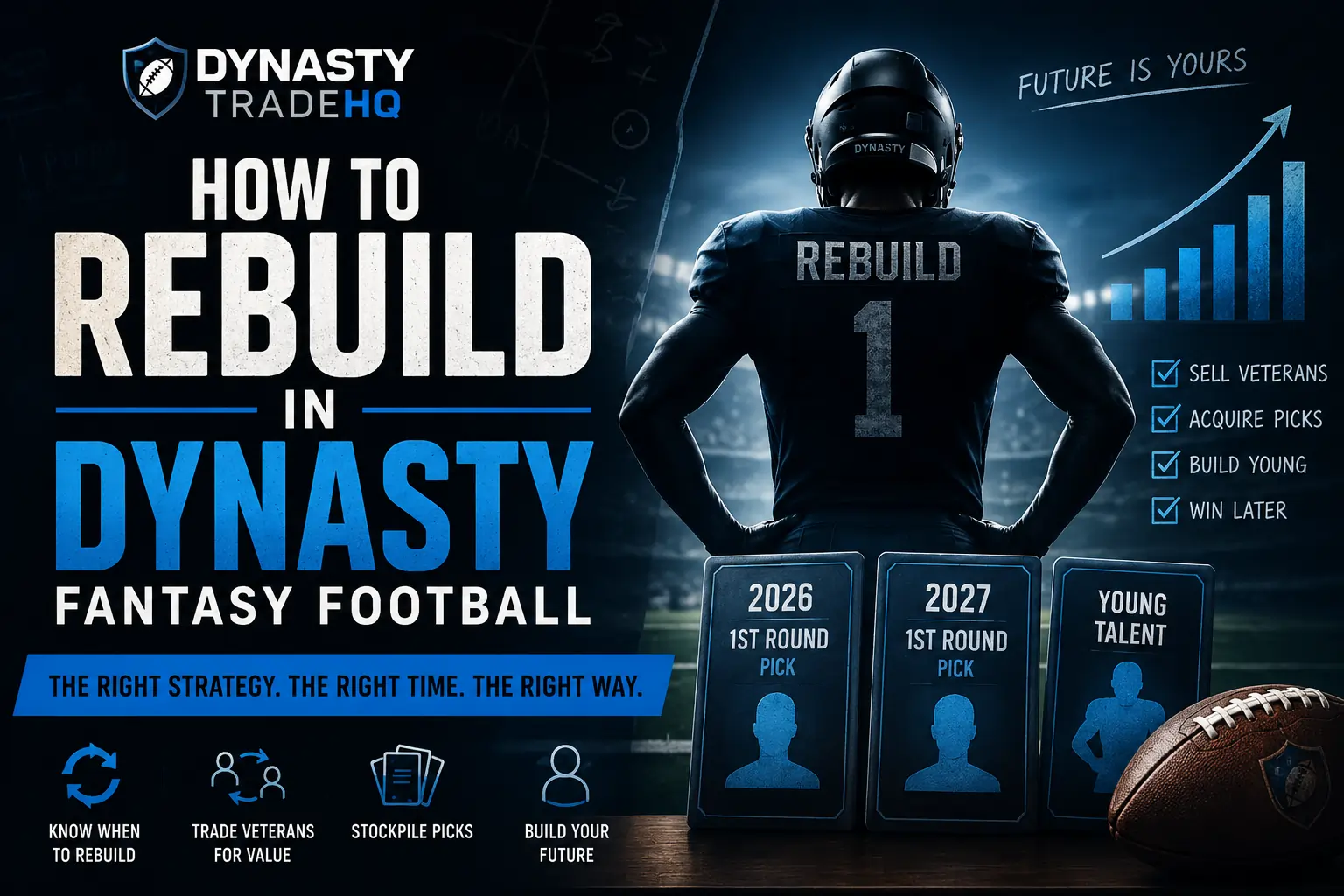
People always ask, “How to rebuild in dynasty fantasy football? A dynasty rebuild is not a bad season. It is a deliberate decision to trade present-day production for future capital, and the managers who execute it well end up with a title window that lasts three to four years. If your roster is aging, your picks are gone, and you are grinding for a sixth-place finish, this guide walks you through the dynasty rebuild strategy you need to turn things around fast. Before you start moving pieces, run your current roster through the trade calculator to see where your assets actually stand. What you think veterans are worth and what the market will pay are often two different numbers.
Table of Contents
Rebuild vs. Retool: Know Which One You Actually Need
A dynasty teardown strategy and a retool are not the same decision, and confusing them is how managers end up in a three-year no man’s land with no picks and no studs.
A rebuild means you are starting over. You trade away aging veterans and expiring assets for future draft capital and young players with long runways. Your goal is to accumulate picks, stack your roster with players under 25, and accept that you will not compete for a title this season or likely next season. A rebuild is correct when your best players are 29 or older, your draft picks for the next two years are gone, and your win total does not justify holding the roster together.
A retool is different. A retool means your core is still competitive, but one or two positions are weak. You make a targeted trade or two, maybe moving a depth piece or a mid-round pick, and your title window stays open. A retool is correct when you have two or three players under 27 at key positions and a realistic shot at the playoffs this season.
The mistake most managers make is retooling when they should be rebuilding. They hold aging running backs one year too long because the production is still there, then watch the value evaporate when the player hits 31 or 32, and the market dries up. At that point, you get pennies on the dollar instead of the first-round picks you could have had two years earlier.
If you are unsure which situation you are in, list every player on your roster, along with their age and dynasty ranking. If more than half of your top 12 starters are 28 or older and your next two rookie drafts are owned by other teams, that is a rebuild situation.
When to Pull the Trigger on a Dynasty Rebuild
Timing is the most important variable in a dynasty teardown strategy. Move too early, and you give up production before the value window closes. Move too late, and you are selling declining assets for worse returns.
The clearest signal to start a rebuild is when your best players are still producing, but the market values them at or near their ceiling. That is the exact moment to sell. Dynasty value for most non-quarterback positions peaks when a player is still putting up strong numbers, but age or contract situation creates doubt among buyers. A wide receiver coming off his best season at age 29 is worth more right now than he will be in 12 months.
Three specific roster conditions should prompt you to rebuild immediately.
First, your oldest starters are running backs over 28 years old. Running backs have the shortest shelf life of any skill position in dynasty, and the market tends to discount them aggressively past that age. Second, you have no first-round picks in the next two drafts. Without draft capital, you have no path to restocking with young talent at a reasonable cost. Third, you finished outside the top half of your league last season, and your roster construction is not going to change that without significant moves.
You do not need all three conditions to rebuild, but two of them together are usually enough. The manager who waits for the roster to fall apart before selling will always get worse value than the manager who sells one year before the decline starts.
How to Sell Aging Veterans at Peak Value
Selling veterans at peak value requires honesty about who is actually declining and who just had a bad season. A bad season can tank a player’s trade price without changing his long-term trajectory, which creates buying opportunities. A genuine decline, especially at running back, means the value is not coming back.
The most important rule when selling veterans is to lead with their most recent production, not their age. If a player just had a strong season, his trade value is at its highest point, and the market is primed. Waiting until the first signs of decline appear means waiting until other managers have already priced that risk in.
Derrick Henry is the textbook example of this dynamic. Henry is entering his age-32 season with the Baltimore Ravens and is still one of the most productive running backs in the NFL. His dynasty value is elevated right now because he continues to perform at an elite level. But 32-year-old running backs do not have a long runway, and any manager holding Henry should be actively exploring what the market will pay. Check the current dynasty valuation at Derrick Henry player values.
When approaching a trade partner, frame the offer around the veteran’s value in the current season rather than the future. Most rebuilding managers are happy to take on a productive veteran for a pick or a young player, because they want to improve now. That motivation works in your favor as a seller.
Target managers who are one piece away from contending. They are the most motivated buyers, and they will often overpay in picks or young talent to add a proven commodity at a key position.
Which Positions to Target During a Dynasty Rebuild
Not all positions return the same value in a dynasty rebuild. Your goal is to acquire assets that give you both starting value in two to three years and high dynasty upside beyond that.
Wide receivers are the single best target during a rebuild. Wide receivers have the longest production windows of any skill position, with many producing at an elite level from age 22 through 30. A wide receiver under 24 who has already earned a starting role in the NFL is one of the most valuable dynasty assets you can hold. Target them aggressively, even if it costs you a veteran plus a pick. The long runway justifies the cost.
Running backs under 24 are worth targeting, but with tighter criteria. The position carries more risk and a shorter shelf life. Focus on running backs who are already the clear lead back on their team, not backfield committee members or handcuffs. An early-down back in a good offense under 23 is a genuine rebuild asset. A backup who might take over someday is not worth premium capital.
Quarterbacks are a lower priority unless you are in a Superflex or two-QB format. In those formats, a young quarterback under 25 with starting upside should be a priority target, because the positional scarcity in Superflex leagues makes them highly tradeable at peak value. Check the dynasty rankings before targeting any position to confirm where value actually sits this cycle.
Draft picks should anchor every rebuild. Understand what each round is realistically worth before you package veterans for capital by checking the dynasty draft pick trade values.
How Long a Dynasty Rebuild Should Take
A well-executed dynasty rebuild should take two to three seasons from start to finish. If your rebuild is dragging into year four or five without a clear contention window in sight, something went wrong in the asset acquisition phase.
In year one, the goal is pure accumulation. You trade veterans, collect picks and young players, and do not worry about your win-loss record. Draft capital is your currency. Aim to enter your year-one rookie draft with at least two first-round picks, ideally three.
In year two, your rookie draft haul starts contributing to lineups. Some of the young players you acquired have developed into starters or near-starters. You may still be trading some depth for better picks, but the shape of your future roster is becoming clear. If you landed a top-five pick in year one, that player could already be a difference-maker.
By year three, you should be in or near contention. The players you acquired in year one are typically 22 to 24 years old, still ascending, and capable of carrying a lineup. If your rebuilding trades went well, you have young starters at wide receiver and running back, plus enough picks to keep adding talent.
The managers who take five or six years to rebuild typically made one of two mistakes: they sold too slowly in year one and missed the value peak on their veterans, or they targeted the wrong positions and ended up with aging players who did not fit a rebuilding profile.
Is It Time to Rebuild in Dynasty? Here Is the Bottom Line
If your roster is aging, your picks are mortgaged, and your realistic ceiling this season is a wild-card loss, the answer is probably yes. Stop retooling and start rebuilding. Sell the veterans who have value today, target wide receivers and backs under 24, and stack picks from the next two drafts.
If a trade is on the table, know exactly what you are getting before you accept it. Run Your Trade Through the Calculator
FAQs
When should I rebuild in dynasty?
Rebuild when your oldest starters are running backs over 28, your next two rookie drafts are traded away, and you finished outside the top half of your league. Waiting for the roster to fully decline before selling means getting significantly lower returns on your veterans.
How do I trade for picks in a dynasty rebuild?
Target is contending that managers are missing one key player. Offer a productive veteran they can start immediately in exchange for a future first or second-round pick. Package two aging depth pieces together if needed. The contender gets immediate help, and you get draft capital to rebuild.
How long does a dynasty fantasy football rebuild take?
A well-executed rebuild takes two to three seasons. Year one is the accumulation of picks and young players. Year two, your draft haul fills lineup spots. By year three, you should have a realistic contention window with a young ascending core in place.
What positions should I target in a dynasty rebuild?
Wide receivers under 24 who are already starting in the NFL are the highest priority due to their long production windows. Running backs under 23 who are clear lead backs are also strong targets. First-round picks in the next two drafts should anchor every rebuild above any individual player.
